According to Visa Onchain Analytics, more than $272 billion in stablecoins are currently in circulation, with adjusted transaction volume over the trailing 12 months at roughly $10.2 trillion. Those numbers say something beyond market size: they show how actively digital assets move between users, services, and blockchain networks.
The user journey is shifting along with that scale. Receiving a digital asset is increasingly just the first step. Next comes holding it, verifying an address, sending part of it to another user, swapping one asset for another, waiting for the right rate, or checking past activity.
When each of those actions needs its own service, the hard part stops being any single operation. It becomes managing the whole sequence.
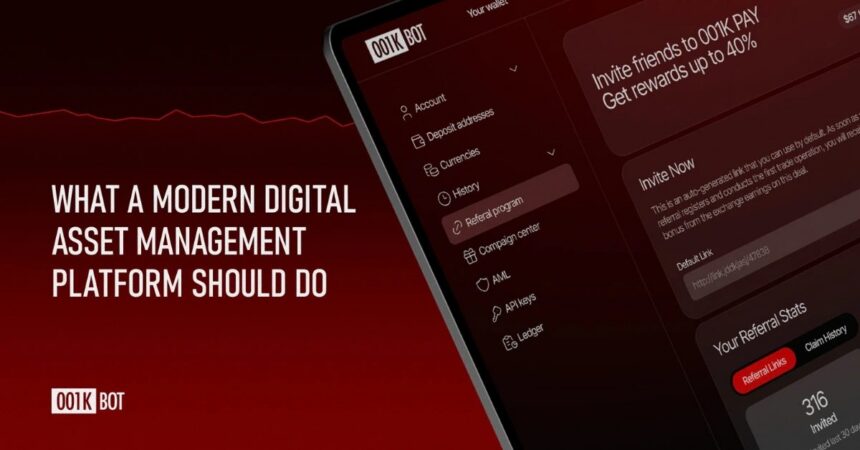
001k.bot is a crypto-financial platform for managing digital assets through web and Telegram interfaces. Its product logic is built around the connections between a user’s actions, not around any single function.
One Workflow Instead of Several Services
Picture a user who regularly gets paid in USDT. Part stays in the balance, part gets converted to USDC for the next transaction, and part goes to a contractor. Before sending funds, they need to verify the address, and at the end of the month, they need to review the history and reconcile everything.
In that scenario, no single wallet, swap, or transfer solves the problem on its own. The value comes from moving through the entire route in one system.
Balance as a Starting Point, Not an End Function
Holding digital assets is only the first step in managing them. Users need to see more than a total figure; they need to see the structure of that balance: which assets they hold and what they can do with them next.
That’s why a balance becomes more useful when it connects directly to other functions. On 001k.bot, users can move from their balance straight into a transfer, a swap, or another operation, without shifting assets between separate services.
Fast access to receiving addresses matters just as much, especially for anyone who regularly accepts assets from clients, counterparties, or partners.
A modern crypto wallet is no longer just a place where funds “sit.” It’s the starting point for whatever comes next.
Transfers: When the Same Action Becomes Routine
Transfers are one of the most common operations with digital assets, whether that means sending funds to an external address or receiving assets from someone else.
Before confirming a transfer, users need to understand the basics: which asset is moving, which network it’s on, which address it’s going to, and under what conditions. Double-check the network and the recipient’s address before confirming, since a mistake at that level usually can’t be undone.
For regular transfers, an Address Book helps: it saves the addresses users rely on so they don’t have to re-enter them every time. That matters especially for contractors, freelancers, or partners, where the same details get used month after month.
Beyond transfers to external addresses, the platform supports internal transfers between 001k.bot users, a fast way to settle up within the same ecosystem without touching the blockchain.
Withdrawals to fiat are the natural next step: 001k.bot lets users withdraw digital assets when the end goal isn’t a crypto balance but money they can spend directly. That covers a practical case where receiving a stablecoin is a step along the way, not the destination.
Swaps Without Leaving the Platform
A swap changes the makeup of a user’s assets within the same workflow: instead of leaving the platform to exchange one asset for another, the user does it where their funds already live and move.
People swap for different reasons. Sometimes a user wants to shift part of their balance into a more stable asset. Sometimes they need to prepare funds for a specific transfer or withdrawal that calls for a particular token. Either way, the exchange terms (the rate, the fee, the amount received) must be clear before confirmation, not described vaguely as “a good rate.”
A common example is swapping USDT for USDC. Both are dollar-pegged stablecoins, but they can differ in network availability, transfer fees, or compatibility with certain services. A swap between them inside 001k.bot lets a user move from one stablecoin to the other without withdrawing to an outside service, so there are no extra fees for withdrawing and re-depositing. For anyone who works with stablecoins regularly, that’s mainly a way to save on fees.
Whatever comes out of a swap lands on the same balance, so the user can move straight into holding, transferring, or withdrawing it, without breaking the flow.
Limit Orders: Set a Condition Instead of Watching the Rate
A limit order is an alternative to swapping instantly at the current rate. A user doesn’t have to exchange an asset right now; they can set the terms they want, such as the rate they’re willing to accept, and wait for the market to meet those terms.
That removes the need to track rate changes manually. The user sets the condition once and comes back to the result.
A limit order doesn’t guarantee execution or promise a profit; it only defines the condition under which a swap can happen. That’s what turns the platform from a simple exchange tool into a system where users set their own terms instead of just reacting to whatever the rate happens to be.
AML Checks Before the Transaction
AML checks on addresses and transactions are another piece built directly into the platform’s interface. They help assess the risk tied to a specific address or incoming assets: its on-chain history and any markers of suspicious activity.
Where assets came from and an address’s history can matter before the funds are used further, which is why the check happens early rather than after the fact. It doesn’t replace other safeguards like 2FA, Passkey, or access controls; it adds another layer alongside them.
Building AML checks into the interface means users don’t need a separate external service. The check happens right where the transaction does.
A History That Shows Where the Funds Went
Transaction history tracks everything that’s happened to a user’s assets, not just a list of transactions.
A single history view covers the operation type, asset, amount, date, status, and address, which is enough to reconstruct any action without contacting support. Say a user receives a stablecoin, sends part of it to a contractor, swaps part of it, and holds the rest: the history lets them retrace that whole sequence in one place.
Clear status on every operation reduces uncertainty: users can see exactly where an action stands without waiting for support to confirm it. The more types of operations a user runs (transfers, swaps, limit orders), the more valuable a single unified history becomes.
When Volume Grows: Mass Payments and API
Telegram remains one way to access 001k.bot: fast and familiar for repeat actions.
The web version is built for more complex scenarios: reviewing balances, history, addresses, and operation details is simply easier on a larger screen. For business users managing multiple payouts, mass payments, or an API integration, the web platform offers more control than sending commands one at a time in a chat.
Both interfaces run on the same product logic: whatever a user can do in Telegram, they can do on the web, and vice versa. Users pick the format that fits the task at hand: a quick action in chat or focused work in a browser.
Who Needs a Platform Rather Than a Standalone Crypto Service
001k.bot is built primarily for people for whom digital assets have already become part of their regular financial routine.
That includes users who consistently receive and send stablecoins, freelancers and business owners who get paid in digital assets, and teams that need to organize payouts or fold crypto operations into their own processes.
Crypto market experience isn’t the deciding factor here. What matters more is how many different tasks a user has to handle once a digital asset lands on their balance.
What Actually Defines a Connected Workflow
A modern platform for managing digital assets isn’t defined by how many features sit in its menu. Its value shows up when individual actions come together into a coherent workflow:
Receive an asset → hold it → verify it → transfer or swap it → track the outcome in the transaction history.
001k.bot is a standalone crypto-financial platform, where web and Telegram aren’t separate services but two ways to access one system for managing digital assets.