


Story Highlights
- The live price of the Tezos token is Loading live price
- The XTZ price could soar as high as $0.40 in 2026
- By 2030, Tezos could aim for $5.40 if its self-amending model proves sustainable
Tezos is a high-performance, open-source blockchain built for assets and applications, with a strong focus on security, on-chain governance, and decentralization.
Its native token, XTZ, plays a key role in the network. It is used to pay transaction fees, secure the blockchain through staking (also known as baking or delegating), earn rewards, and participate in governance decisions.
Over the years, XTZ has lost nearly 94% of its value, causing many investors to lose confidence. However, the token has recently shown signs of recovery, drawing attention from the market once again.
So, is Tezos making a comeback? Let’s explore Tezos XTZ price predictions for 2026, 2027, and 2030 to find out.

Table of contents


Tezos Price Today
| Cryptocurrency | |
| Token | |
| Price | |
| Market Cap | |
| 24h Volume | |
| Circulating Supply | |
| Total Supply | |
| All-Time High | |
| All-Time Low |
Why Is XTZ’s Price Up Today?
Tezos (XTZ) is moving higher alongside Bitcoin and the broader crypto market, which gained around 0.9% over the past 24 hours. Bitcoin’s recovery was partly driven by short covering during thin Thanksgiving trading. XTZ has gained more than the wider market, showing stronger performance.
However, XTZ’s 24-hour trading volume fell 10.18%, indicating that the price rise is not backed by stronger trading activity.
XTZ is trading near $0.215, with support around $0.215 and $0.213 and resistance near $0.222. If it holds above $0.215, it could test $0.222. A drop below $0.213 may push it toward $0.210.
Tezos Price Prediction 2026
In the middle of the final quarter of 2026, Tezos (XTZ) could see stronger demand as network upgrades and tokenomics improve its long-term outlook. The Adaptive Inflation model adjusts token emissions based on staking participation, helping control inflation as more XTZ is staked.
At the same time, network activity can support token scarcity by burning a portion of transaction and smart contract fees.
On the development side, Tezos is focused on scaling its ecosystem through Smart Rollups and Etherlink. Etherlink, its EVM-compatible Layer-2, allows developers to build Ethereum-based applications with low transaction costs while expanding Tezos’ utility.
If these upgrades drive higher network activity and demand, XTZ could gain stronger momentum in the second half of 2026.
Tezos (XTZ) Technical Analysis
Looking at the daily price chart, Tezos is currently trading around $0.2116 and has started consolidating near the $0.20–$0.21 zone after its recent decline. This area is important because holding it could give buyers a base for a recovery.
The first major resistance is $0.2850. XTZ needs to break above this level to show stronger buying pressure and confirm that the current sideways move is turning into an upward recovery.
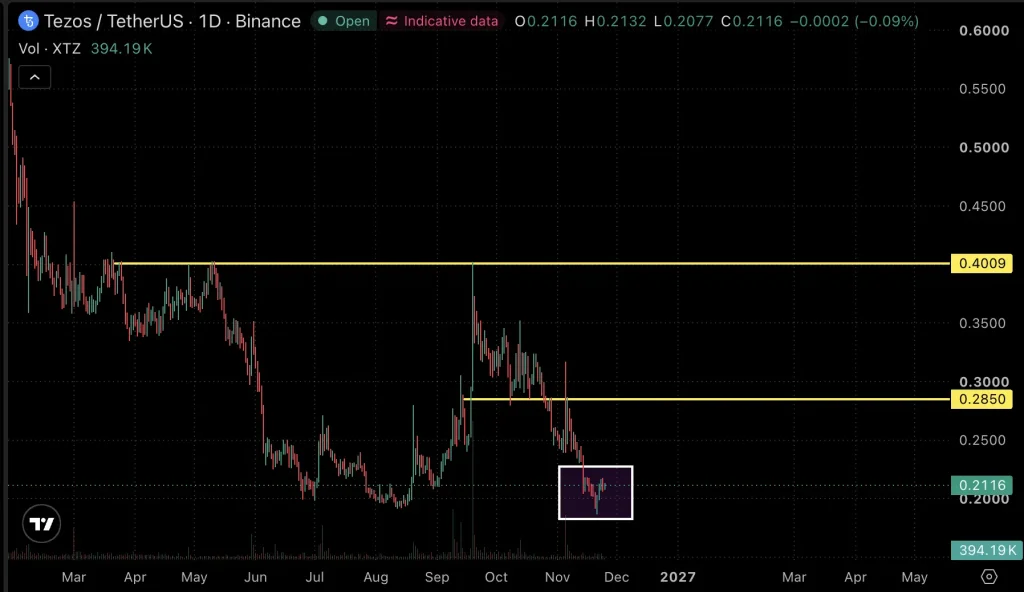
If the breakout happens, the next major target is $0.4009, which is the key resistance shown on the chart.
For now, the setup remains neutral with a bullish recovery possibility. Holding around $0.20 keeps the setup intact, while a breakout above $0.2850 could open the way toward $0.4009.
| Year | Potential Low ($) | Potential Average ($) | Potential High ($) |
| XTZ Price Prediction 2026 | $0.1780 | $0.2850 | $0.4012 |
Tezos (XTZ) Price Prediction 2026 – 2030
| Year | Potential Low ($) | Potential Average ($) | Potential High ($) |
| 2026 | $0.178 | $0.2850 | $0.401 |
| 2027 | $0.316 | $0.53 | $0.908 |
| 2028 | $0.59 | $3.82 | $2.15 |
| 2029 | $0.82 | $1.843 | $3.88 |
| 2030 | $1.215 | $3.14 | $5.40 |
Tezos Price Prediction 2026
The Paris upgrade and growing Etherlink activity could increase network usage and demand for XTZ, helping the price reach $0.4012.
Tezos Price Prediction 2026
Wider adoption of Smart Rollups and stronger institutional use could bring more liquidity to the Tezos ecosystem, pushing XTZ toward $0908.
Tezos Price Prediction 2028
The expansion of zero-knowledge (ZK) tools could attract more businesses to Tezos and increase demand for the network, taking XTZ to $2.15.
Tezos Price Prediction 2029
A stronger altcoin market and rising cross-chain activity could support further gains for XTZ, with the price potentially reaching $3.88.
Tezos Price Prediction 2030
Greater adoption of Tezos’ self-amending governance and growing transaction activity could strengthen its long-term utility, potentially pushing XTZ to $5.40.
What Does The Market Say?
| Year | 2026 | 2027 | 2030 |
| Coincodex | $0.696 | $0.652 | $0.5434 |
| Binance | $0.563 | $0.59 | $0.687 |
| DigitalCoinprice | $0.98 | $1.35 | $3.50 |
CoinPedia’s Tezos (XTZ) Price Prediction
From a CoinPedia perspective, Tezos is best viewed as an infrastructure-first blockchain, not a momentum-driven asset.
Rather than expecting sharp rallies, CoinPedia analysts expect XTZ to reflect progress gradually. If Etherlink succeeds in attracting EVM liquidity and Tezos X delivers tangible scalability improvements, XTZ could work its way toward the $0.4012 level during 2026.
| Year | Potential Low ($) | Potential Average ($) | Potential High ($) |
| XTZ Price Prediction 2026 | $0.1780 | $0.2850 | $0.4012 |
Never Miss a Beat in the Crypto World!
Stay ahead with breaking news, expert analysis, and real-time updates on the latest trends in Bitcoin, altcoins, DeFi, NFTs, and more.
FAQs
Tezos shows early recovery signs in 2026, supported by technical breakouts and upgrades like Etherlink, but sustained growth depends on real adoption.
Tezos suits long-term investors who value security and governance over hype, offering steady growth potential rather than fast speculative gains.
Tezos price in 2026 may range between $0.1780 and $0.4012, driven by network upgrades, Etherlink growth, and steady ecosystem adoption.
XTZ could trade between $0.316 and $0.908 in 2027 if governance-led blockchains gain traction and Tezos expands real-world use cases.
By 2030, XTZ may reach up to $5.40 if Tezos proves its long-term value through secure upgrades, institutional use, and strong governance.