Story Highlights
- The live price of the Polygon coin is Loading live price .
- POL price prediction for 2026 suggests potential highs of $0.25055.
- Long-term forecasts indicate POL could reach $4.94 by 2030.
Polygon (POL), formerly MATIC, remains one of the most recognized scaling ecosystems built around Ethereum. Designed to improve transaction speed and reduce fees, the network has grown into a multi-layer infrastructure supporting decentralized finance, gaming platforms, and enterprise blockchain applications.
The transition from MATIC to POL reflects Polygon’s broader ambition to build a multi-chain ecosystem, where the token supports multiple networks within the Polygon architecture. As Ethereum continues expanding its ecosystem, scaling solutions such as Polygon are expected to play a significant role in supporting decentralized applications.
However, proposed token buybacks and burns could further support its long-term value by reducing circulating supply
With these developments in focus, let’s dive into the Polygon (POL) price prediction for 2026–2030 and explore its potential future price targets.

Polygon Price Today
| Cryptocurrency | |
| Token | |
| Price | |
| Market Cap | |
| 24h Volume | |
| Circulating Supply | |
| Total Supply | |
| All-Time High | |
| All-Time Low |
Why Is Polygon (prev. MATIC) Price Dropping?
Polygon’s POL is down 2.17% to around $0.0953, as broader crypto weakness puts pressure on the token. Bitcoin fell 1.51%, while the total crypto market cap declined 1.26%, triggering selling across major altcoins.
POL is also facing exchange related concerns, after Chile-based Orionx began shutting down following a forensic audit that found more than $7 million in customer assets moved to wallets outside its control.
POL was among the affected assets, and Orionx has temporarily suspended withdrawals during its restitution process.
At the same time, POL’s 24-hour trading volume fell 12.31% to $44.56 million, showing weaker buying support. If POL holds $0.09, it could recover toward $0.10; losing this level may expose $0.085 support.
Polygon (POL) Price Prediction 2026
Polygon is focusing the second half of 2026 on faster transactions, lower fees, and wider business use. The upcoming Ithaca hard fork is aimed at improving network safety and transaction speed, while Polygon’s long-term Gigagas plan targets up to 100,000 transactions per second.
Polygon is also building its role in digital payments and stablecoins, with projects such as PYUSD and other payment platforms adding to network activity.
Another factor to watch is the token supply. Under the proposed treasury changes, 20% of quarterly net cash inflows could be used for POL buybacks and burns. Monthly burns are reportedly reaching 1 million to 10 million POL, which could reduce supply over time.
Polygon (POL) Price Prediction: Technical Analysis
Looking at the Polygon daily price chart, POL shows a recovery from a long term downtrend, with the price currently around $0.096. The chart shows POL forming a base near the $0.068 support, followed by a sharp rebound toward the $0.118 resistance area.
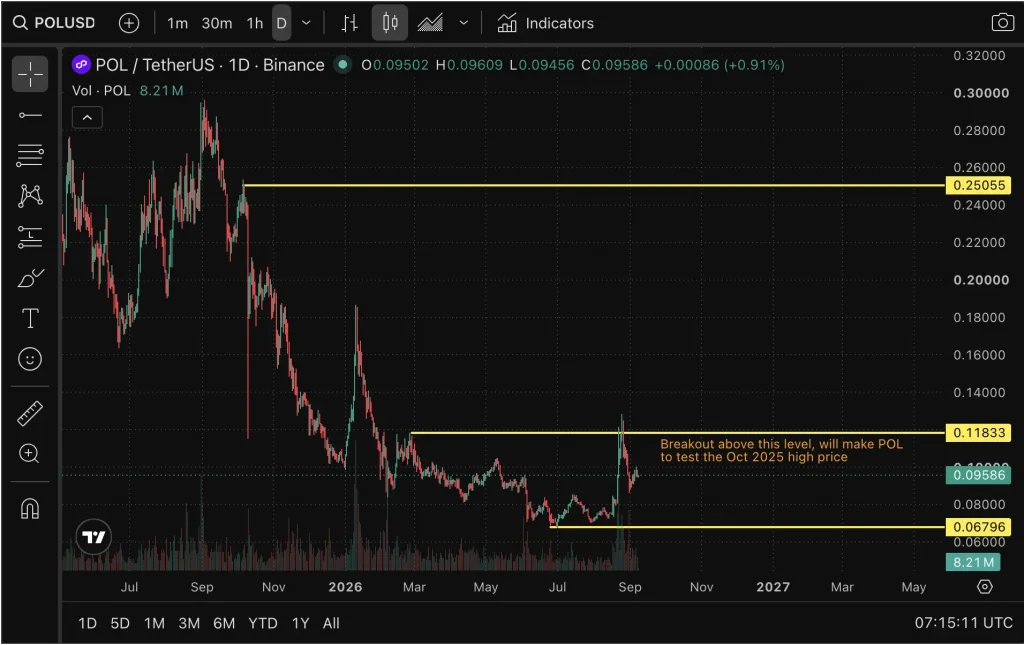
The key level to watch is $0.11833. A strong daily close above this resistance would confirm a breakout from the current consolidation and could open the path toward the October 2025 high, as shown on the chart. If buyers fail to break $0.11833, POL could continue moving sideways.
On the downside, $0.06796 is the major support. Holding this level would keep the recovery structure intact, while a breakdown could signal renewed selling pressure.
| Year | Potential Low ($) | Potential Average ($) | Potential High ($) |
| Polygon Price Prediction 2026 | $0.06796 | $0.11833 | $0.2505 |
POL On-Chain Analysis
The on-chain landscape for POL is flashing a major recovery signal as the 30-day moving average of Daily Active Addresses (DAA) shows a clear and sustained upward trend in early 2026.
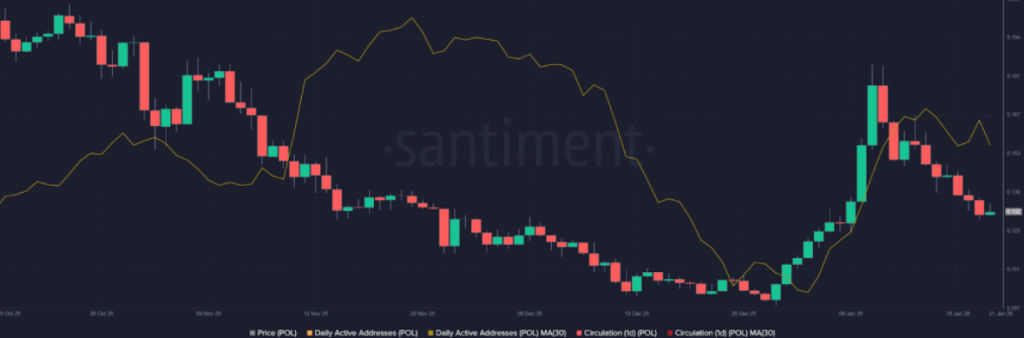
This metric serves as the vital heartbeat of the ecosystem, indicating that organic utility and user engagement are returning to the network at a steady, reliable pace. Unlike temporary spikes that often signal speculative noise, a rising 30-day average suggests a strengthening network effect and a growing demand for blockspace. For investors, this return of on-chain activity is a fundamental precursor to price appreciation, as it confirms that the ecosystem is not only retaining its base but actively expanding its reach.
Complementing this surge in network activity is a powerful development in supply distribution, specifically within the “whale” and institutional cohorts. Addresses holding between 100,000 and 10 million POL have seen significant growth, signaling a phase of high-conviction accumulation by “smart money.”
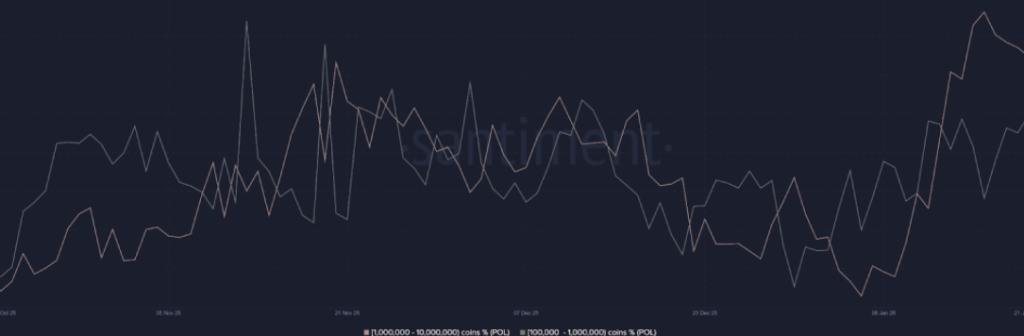
This specific bracket often represents mid-to-large-scale investors who lead market cycles by absorbing supply during consolidation phases. This strategic positioning by larger entities reduces sell-side pressure and creates a robust fundamental floor for the asset.
When rising active addresses align with such aggressive whale accumulation, it speaks a definitively bullish language for the POL trajectory, suggesting that the most influential market participants are preparing for a major expansion in value.
Polygon Price Prediction 2026 – 2030
| Year | Potential Low ($) | Potential Average ($ | Potential High ($) |
| 2026 | 0.0679 | 0.11833 | 0.25055 |
| 2027 | 0.0931 | 0.2148 | 0.50782 |
| 2028 | 0.1820 | 0.4574 | 0.93252 |
| 2029 | 0.4297 | 0.8950 | 2.09205 |
| 2030 | 1.036 | 2.5641 | 4.94729 |
Polygon (POL) Price Prediction for 2026
Agglayer’s production rollout and faster zero-knowledge transactions could strengthen POL utility, supporting a $0.25055 target by 2026.
Polygon (POL) Price Prediction for 2027
In 2027, broader Polygon CDK adoption and institutional blockchain deployments could expand POL demand, supporting a $0.5078 target.
Polygon (POL) Price Prediction for 2028
Growing POL staking and expanding multi-chain utility could lock more tokens, pushing prices toward $0.9325 in 2028.
Polygon (POL) Price Prediction for 2029
A stronger altcoin cycle and wider cross-chain adoption could lift POL toward $2.092 as Polygon’s ecosystem expands.
Polygon (POL) Price Prediction for 2030
By 2030, mature ZK infrastructure, institutional adoption, and higher network activity could drive POL toward $4.947.
Polygon Price Prediction 2031, 2032, 2033, 2040, 2050
The long-term projection assumes Polygon sustains relevance in enterprise blockchain use cases, with growth moderating over time as the asset matures.
| Year | Potential Low ($) | Potential Average ($) | Potential High ($) |
| 2031 | 2.50 | 4.00 | 6.00 |
| 2032 | 3.00 | 5.00 | 7.20 |
| 2033 | 4.20 | 6.50 | 8.50 |
| 2040 | 14.20 | 24.30 | 35.00 |
| 2050 | 28.20 | 35.50 | 50.00 |
Polygon (POL) Price Prediction: Market Analysis?
| Year | 2026 | 2027 | 2030 |
| Changelly | $ 0.50 | $1.50 | $2.90 |
| CoinCodex | $0.26 | $$1.75 | $3.80 |
| WalletInvestor | $0.36 | $$1.88 | $2.08 |
CoinPedia’s Polygon Price Prediction
Polygon is shifting toward a faster, more scalable blockchain network with a stronger focus on institutional payments, real-world use cases, and lower transaction costs. Its upgrades and POL token-burn plans could support long-term demand if network activity continues to grow.
As per CoinPedia’s price prediction, POL could see steady growth in 2026, with a potential high near $0.25055 provided it breaks key resistance levels and the broader crypto market turns bullish.
| Year | Potential Low ($) | Potential Average ($) | Potential High ($) |
| Polygon Price Prediction 2026 | $0.0679 | $0.11833 | $0.25055 |
Never Miss a Beat in the Crypto World!
Stay ahead with breaking news, expert analysis, and real-time updates on the latest trends in Bitcoin, altcoins, DeFi, NFTs, and more.
FAQs
Polygon is considered a strong long-term project due to its Ethereum scaling role, active development, and growing ecosystem, but it still carries market risk.
Polygon could reach up to $0.2505 in 2026, depending on market conditions and continued network growth.
Forecasts suggest POL could reach around $4.94 by 2030 if adoption grows and Polygon strengthens its role in scaling Ethereum.
Long-term projections vary, but sustained adoption and strong ecosystem growth could push POL significantly higher over time.
By 2050, POL’s price will depend on global blockchain adoption, but strong infrastructure use could support substantial long-term value.