
Bitcoin has lost more than half its value from its October 2025 peak, but BlackRock does not see the correction as a breakdown of the Bitcoin thesis. Instead, the asset manager sees leverage, changing capital flows and macro expectations as the main forces behind the sell-off.
That distinction matters because BlackRock’s long-term case is now less about Bitcoin simply going up and more about where the asset could fit inside diversified portfolios over the next decade.
The Crash Was About Positioning, Not Bitcoin’s Core Case
Bitcoin climbed to around $126,000 in October 2025 before falling toward $60,000 in 2026. BlackRock attributes much of that decline to excessive leverage and changing market positioning.
Crypto futures open interest had climbed above $90 billion near the peak, with roughly 80% coming from perpetual futures outside CME markets. When tariff shocks and changing rate expectations hit risk assets, liquidations accelerated the decline.
BlackRock also pointed to long-term holders adjusting positions around the psychologically important $100,000 level and weaker demand from digital-asset treasury companies.
The $60B ETF Inflow Story Still Matters
Spot Bitcoin ETPs attracted around $60 billion in cumulative inflows from their launch through October 2025. That was followed by more than $5 billion in net outflows as investor attention moved toward other areas, including AI-focused funds that attracted more than $46 billion during the same period.
BlackRock’s argument is that these changing flows do not necessarily mean investors have abandoned Bitcoin. They show how quickly capital can rotate when market narratives change.
Why BlackRock Still Sees Bitcoin In Portfolios
BlackRock’s long-term case rests on several factors:
- Bitcoin has a fixed supply that cannot be increased by a central bank.
- Institutional access has expanded through regulated ETPs.
- Regulation has become more supportive of digital assets.
- Bitcoin can behave differently from traditional assets.
- The asset may offer protection against declining fiat purchasing power.
The firm’s updated 10-year portfolio analysis also found that a 1%–2% Bitcoin allocation could improve risk-adjusted returns for a traditional 60/40 portfolio, although the outcome depends heavily on the period and assumptions used.
Bitcoin Current Market Outlook
On-chain analysis by CryptoQuant reveals that Bitcoin’s spot demand is close to turning positive for the first time since February, which could be an encouraging sign after the recent sell-off.
Historically, when spot demand has made a similar shift, Bitcoin has posted a median gain of around 18.1% over the following 60 days, with a 78% win rate. At heavily depressed valuations, the historical win rate rises to 87%.
Glassnode is also seeing signs that stronger holders are stepping in to buy Bitcoin. The firm says the current setup looks similar to previous accumulation phases, including the 2022 bottom. It also pointed to the $60,000 area, where conviction buyers previously recorded a substantial increase in their BTC holdings.
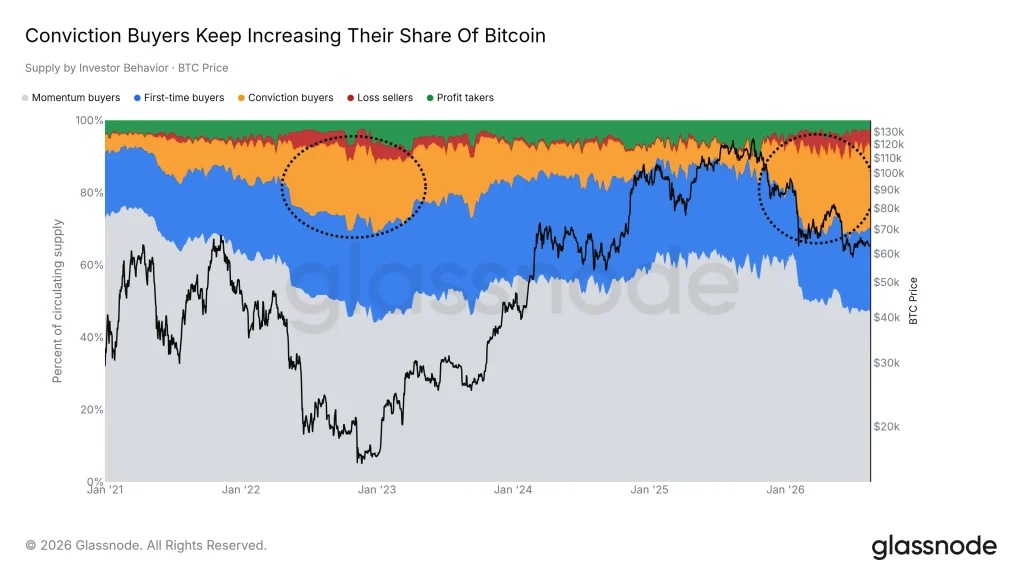
Taken together, the data indicate that buyers are starting to show more interest around lower prices. Still, these are historical and on-chain signals, not a guarantee that Bitcoin has already found its bottom.
Was this writing helpful?
Story Ends Here
Trust with CoinPedia:
CoinPedia has been delivering accurate and timely cryptocurrency and blockchain updates since 2017. All content is created by our expert panel of analysts and journalists, following strict Editorial Guidelines based on E-E-A-T (Experience, Expertise, Authoritativeness, Trustworthiness). Every article is fact-checked against reputable sources to ensure accuracy, transparency, and reliability. Our review policy guarantees unbiased evaluations when recommending exchanges, platforms, or tools. We strive to provide timely updates about everything crypto & blockchain, right from startups to industry majors.
Investment Disclaimer:
All opinions and insights shared represent the author’s own views on current market conditions. Please do your own research before making investment decisions. Neither the writer nor the publication assumes responsibility for your financial choices.
Sponsored and Advertisements:
Sponsored content and affiliate links may appear on our site. Advertisements are marked clearly, and our editorial content remains entirely independent from our ad partners.
Read the Next News