
Ethereum staking participation has never been higher and is at an ATH. But beneath the record-setting headline sits a divergence that fundamentally changes the risk profile of staking: yields are at a three year low, the validator count is recovering from a year-long exit spree, and one leveraged accumulator holds enough staked ETH to flood the exit queue for weeks if its financing structure cracks.
The Record Breaking Ethereum Staking Metrics Disaggregation
At 41.41 Million ETH staked by August 4th 2026, representing 33.98% of the total circulating supply, Ethereum’s staking participation has broken its own all-time high as of August 2026. On its own, this reads as the strongest possible signal of network conviction: nearly one in three ETH is now locked in the validator set, bearing consensus duties in exchange for protocol rewards.
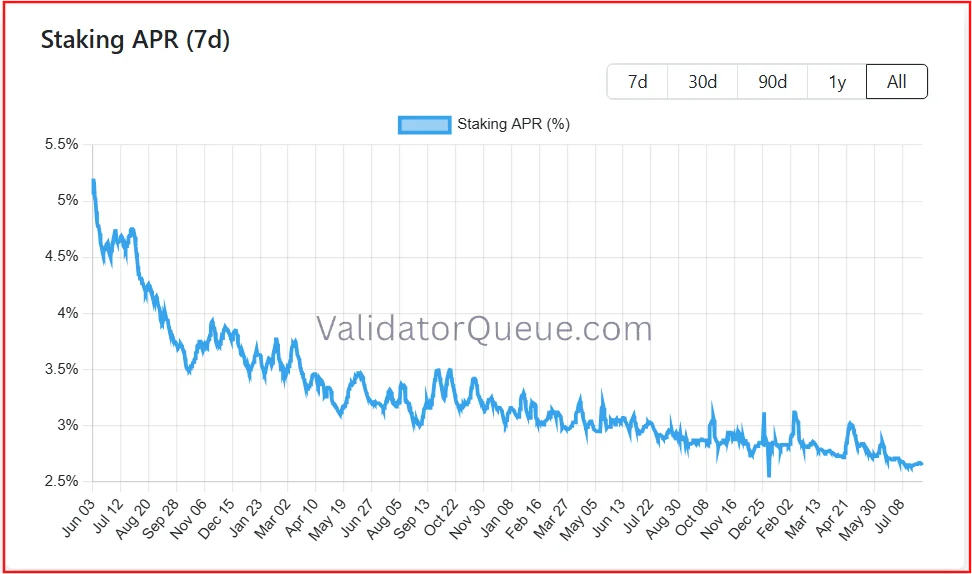
But the same data set that contains the record staked supply also contains its own rebuttal. The 7-day staking APR has fallen to 2.66% down from a peak of 5.06% in June 2023, which is a decline of nearly 47% over three years. More ETH committed to the network means more validators sharing the same fixed issuance pool, which mathematically compresses per-validator rewards. Record participation and record yield compression are not contradictions in fact they are the same phenomenon described from two different angles.
Also read : Ethereum (ETH) Price Prediction 2026, 2027 – 2030: Can ETH Reach $10k?

The practical implications is that validators participants entering the network today for Ethereum staking are earning 47% less in real yield terms than those who entered at the June 2023 peak. That is not a tail-risk scenario but currently it is the current baseline, and it shapes the incentive structure for every new entrant, every liquid staking protocol, and every institution sizing a staking position.
The Active Validator Count: What the U-Turn in August Actually SIgnals
The active validator count peaked at approx 1.09 million in July 2025. What followed was a sustained exit spree, where several months long contraction in the validator set drove the active validators down to approx 880K by mid-2026. The most proximate cause was the sustained compression in staking APR: as yields fell under 3% July 2025 onwards.
Therefore, marginal validators particularly those operating on thin infrastructure margins eventually ended up found staking as increasingly uneconomic and began queuing to exit.
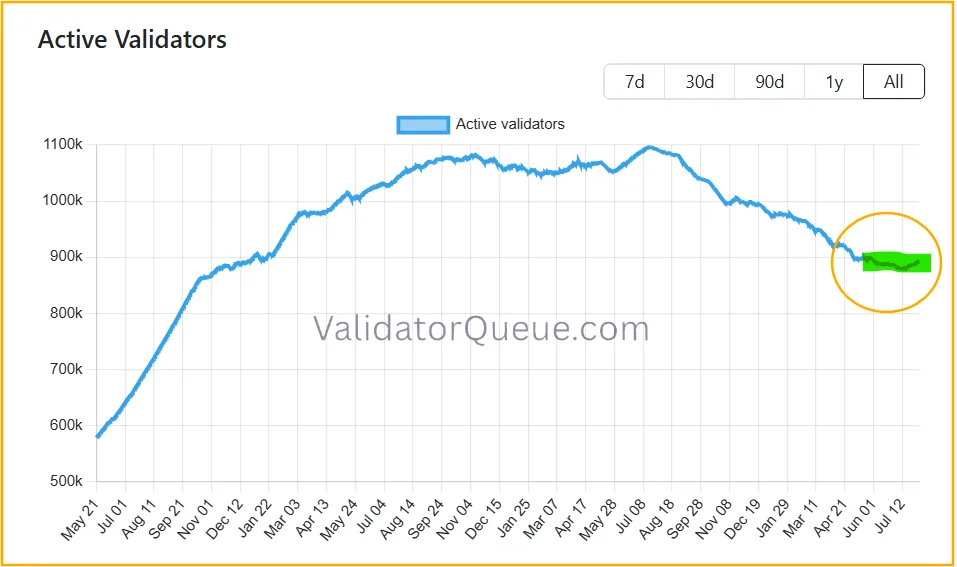
As of early August 2026, that trend has slightly reversed on the upside. Active validators have climbed from 880K back to approx. 893K, which marks a net recovery of 13K validators, representing a meaningful swing formation.
Crucially, this recovery is occurring against the same compressed APR environment that drove the prior exodus. This shows that at this point it seems validators are re-entering or new entrants are replacing those who left due to lower APR’s. This means that the new validators in August 2026 are either more yield-tolerant or perhaps more institutionally collapsed, or could be both.
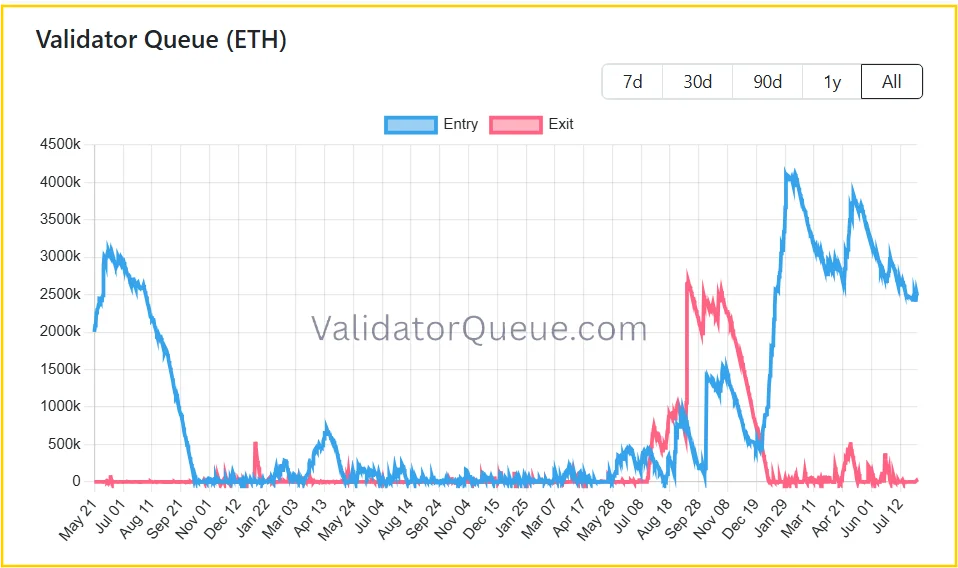
The entry queue data adds more texture. The ETH value queued for entry has contracted sharply from 4.11 million ETH to 2.40 million ETH, a over 41% drop in pending entry volume. This is not a signal of declining interest. It is a signal that the entry queue is clearing faster than new demand is entering it, which is consistent with the validator recovery. So, what it actually means is that a queue backlog that had previously extended wait times for new validators is now normalising, allowing the U-turn in active validator count to manifest.
The Exit Queue is Near-Flat in August, But That is Not the Full Picture
The current exit queue in August 2026 seems mostly flat. This is the observable onchain reality and it is notably different from the elevated exit queue conditions that characterized much of the proceeding 12 months, since July 2025. Taken alone, a flat exit queue in August suggests that the acute phase of validator attrition has passed.
However, a flat exit queue is a current-state metric, not a forward-state guarantee. The structural risk that would simultaneously repopulate that queue sits not in the aggregate validator set but in a single entity’s balance sheet.
Structural Risk Hidden in Bitmine’s Balance Sheet
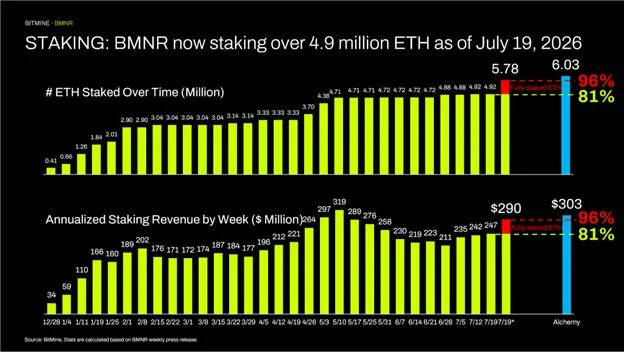
As per a July 20, 2026 SEC filing, bitmine holds around 4.9 million ETH in staked form that’s equivalent to roughly 12% of total ETH supply staked and close to 5% of total circulating ETH supply. The firm has funded this accumulation partly through preferred stock issuance carrying 9.5% annual fixed dividend paid weekly. That financing cost is non-discretionary: regardless of ETH price movements, staking yield fluctuations, or market conditions, the dividend obligation emanates on schedule.
On the Validator queue chart, the reference point was the Kiln incident of September 2025 exactly when the exit queue soared, in this incident nearly 1.6 million ETH were unstaked in a concentrated period, driving exit queue wait times to nearly 50-days. This time around, the Bitmine’s staked position is approx. three times the scale of the Kiln event.
A partial liquidation equivalent to the outstanding preferred stock obligation which is approx $367.5 million, or roughly 5% of Bitmine’s staked ETH. At current ETH prices in 2026 this could add an estimated 5-6 days to the exit queue based on comparable historical ratios.
A deeper distress scenario, particularly one where ETH price moves adversely and the liquidation requirement scales proportionally, would produce substantially longer queue disruptions.
The Kiln incident also surfaced as a secondary dynamic that amplifies the primary shock, during that incident timeline, 21shares report highlighted that there were approximately 400K ETH in additional exits came from validators who were not under any financial distress but who chose to front-run the queue rather than wait behind the forced sellers. If that behaviour repeated at Bitmine scale, the actual queue disruptions would materially exceed the 5-6 day base estimate.
Glamsterdam and EIP-8061: The Asymmetric Protocol Fix
The Ethereum protocol is not static in the face of these dynamics. The Glamsterdam upgrade, which is currently scheduled for Q4 2026, has EIP-8061 under active consideration for inclusion. The proposal removes the validator exit cap and increases the exit churn limit by approx. four times relative to current parameters. Applied retroactively to the Kiln-equivalent distress conditions of late 2025. This would have reduced queue times from approx.50 days to around 12 days, which is indeed a significant improvement but still not a complete elimination of the risk.
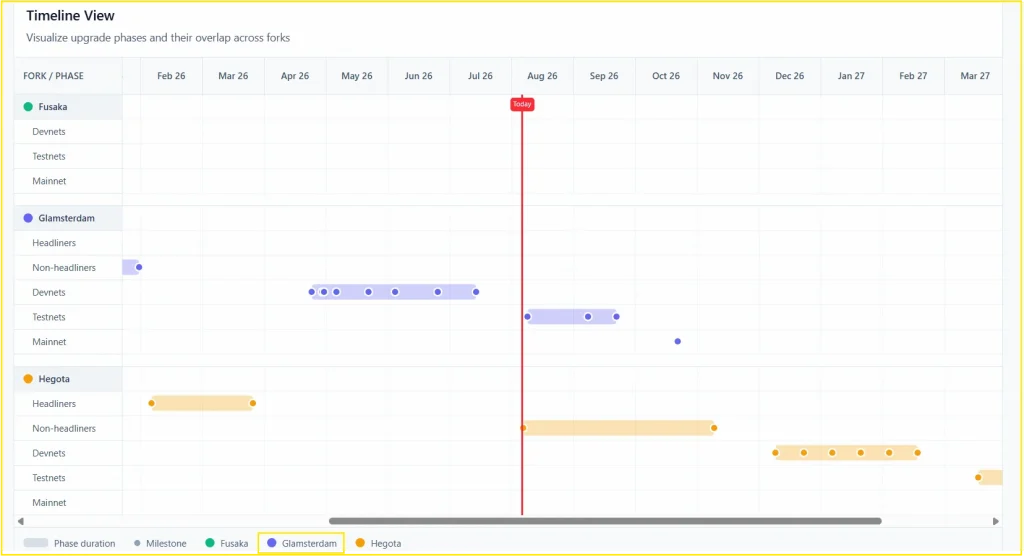
The structural problem with EIP-8061 as a complete solution for Ethereum staking is that it addresses exit-side congestion exclusively. There is no corresponding proposal for entry-side queue management currently on the glamsterdam roadmap. This asymmetry matters because Bitmine has publicly stated its intention to continue accumulating ETH toward what it terms the ‘Alchemy of 5%’ which is a target that implies continued entry-queue pressure from a single concentrated actor. If entry queue congestion becomes the binding constraint rather than exit queue congestion, the protocol improvement addresses the wrong side of the problem.
The current August 2026 data shows this entry-exit asymmetry directly. The exit queue is in near-flat state, which seems normalised by the months of attrition. The entry queue has contracted sharply to 2.40 million ETH showcasing that the backlog is clearing now. Now, where the main focus should be is whether the entry queue normalisation is durable or does it represent a temporary lull before continued institutional-scale inflows re-extend it.
The Divergence That Changes the Staking Risk Calculus
Taken together, the August 2026 Ethereum staking data set presents a picture that aggregate metrics obscure. The record 33.98% participation rate and the 2.66% APR are not two separate data points, in fact they are strongly linked to each other. The validators U-turn with 13K addition is a recovery signal, but one occurring at structurally compressed yields. The entry queue contraction to 2.40 million ETH is a normalisation, not a demand collapse. And the near-flat exit-queue is an accurate description of August conditions, which is not a forward guarantee.
The variable that ties these data points together and that most staking participants are not pricing is basically the structural dependency between Ethereum’s validator exit mechanism and single entity’s preferred stock financing. Bitmine’s shareholders can exit their positions in a secondary market transaction. However, Ethereum’s validators cannot exit easily as they want because they are subject to a queue that, at Bitmine’s scale, could impose multi-week wait periods on every other participant in the set.
That said, EIP-8061 mitigates the exit-side risk materially, if Glamsterdam ships on schedule in Q4 2026. But it does not address the entry-side dynamics that Bitmine’s continued accumulation will create. And it does not retroactively alter the risk exposure of validators who would be in the queue during any distress event that precedes the upgrade’s activation.
Loading article prices