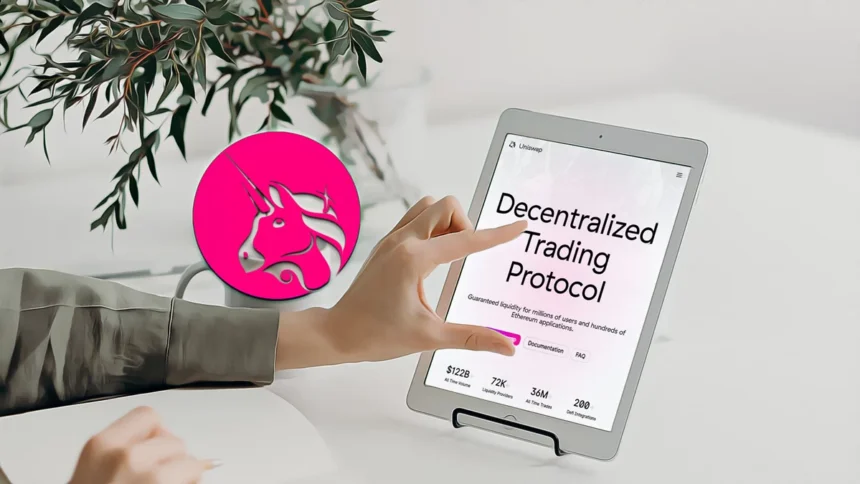
Uniswap Labs has asked UNI token holders to confirm protocol fees on a portion of their Uniswap v4 pools for the next phase of the UNIfication burn program. The voting, which started on July 7 to expand the scope of the program currently implemented on 11 blockchains, is planned to end on July 12.
Voting schedule and scope
The company is conducting a Snapshot voting that will last five days in the first phase. Then, a binding on-chain vote is expected to be held during the week of July 13. The proposal includes the addition of v4 pools to the existing fee and burn mechanism running on Ethereum, Arbitrum, Base, Celo, OP Mainnet, Soneium, X Layer, Worldchain, Zora, BNB Chain and Polygon.
Mini dictionary: Snapshot is a voting system used by decentralized communities off-chain. Although the results are not written directly to the chain, they serve as a reference for subsequent binding voting in the governance process.
Uniswap is known as one of the largest DeFi protocols offering decentralized exchange infrastructure. If the proposal is accepted, an equivalent value of UNI will be burned to collect the protocol’s share of transaction fees, and these tokens will be moved to the Ethereum network and sent to a non-returnable address.
Uniswap Labs launched Snapshot voting, which began on July 7, to include v4 pools in its current fee and burn program; The binding on-chain vote is expected to be held during the week of July 13.
Why is the v4 structure different?
While the fee structure is more fixed in Uniswap v2 and v3 pools, fees may vary from block to block in v4 pools due to the “hook” system. Therefore, v4 integration requires a more complex structure than previous versions. The proposal envisages a two-contract system to solve this problem.
In this structure, the first contract determines the fee rate to be applied for the pool, and the second contract ensures the application of these rules and transfers the fees to the relevant address. This way, the governance side will be able to update the rules in the future by simply changing the policy agreement without rebuilding the entire system.

The offering covers three types of v4 pools: hookless pools, pools created through auction, and pools using aggregator hooks that move externally sourced liquidity into the system. While the fee is determined as 3 basis points in the Base network, it is planned to apply 10 basis points in other networks. It was reported that in pools using collector hooks, the fee may exceed the standard upper limit.
| Network or pool type | Planned fee |
|---|---|
| base | 3 basis points |
| Other networks | 10 basis points |
| Pools using collector hooks | above standard limit |
Discussion in terms of liquidity providers
When protocol fees are activated, a portion of the fees paid by transaction users are transferred to the protocol. This means that liquidity providers who provide capital to the pools are deducted from their income. Therefore, the regulation brought about a new balance debate between the interests of UNI holders and liquidity providers.
Guillaume Lambert, who manages Panoptic, argues that a tax-like fee structure on v4 could drive liquidity providers away from the platform, and this could harm the functioning of the protocol, as there are similar cuts on the v2 and v3 sides.
Burning data and latest growth steps
Uniswap broke a daily record by burning 186 thousand UNIs in one day last month. This level exceeded the previously seen daily peak of 134 thousand UNI. As of July 7, the UNI price is $3.23 and its market value is approximately $2 billion. The token is trading significantly below its May 2021 peak of $44.97.
Despite this, the Uniswap ecosystem continues to expand. The protocol was launched on Robinhood Chain in early July. Here, Uniswap launched v2, v3, v4 and UniswapX products from day one and reached a transaction volume of over 250 million dollars in less than a week.