Story Highlights
- The live price of the Stacks token is Loading live price .
- Price predictions for 2026 range from $0.50 to $2.50.
- Long-term outlook suggests gradual growth potential to approach $20 by 2030.
Stacks is the Bitcoin layer where Bitcoin holders come to grow their BTC through Bitcoin-native finance, and STX is what powers it: the gas asset, the Stacking asset, and soon the capacity asset for a new self-custodial yield product called Bitcoin Staking.
STX trades around $0.27 in late August 2026 after one of its strongest short-term moves of the year. The token was trading near $0.12 in mid-August before more than doubling within roughly a week, reclaiming the $0.20 level and approaching $0.30. The move also illustrates STX’s potential role as a higher-beta Bitcoin asset, amplifying changes in Bitcoin sentiment while adding exposure to growth within the Stacks ecosystem.
The opportunity behind that number is Bitcoin itself: most of Bitcoin’s roughly $1.32 trillion market cap sits idle, and every mechanism below is a different way of turning a sliver of that idle BTC into activity that runs through STX.
This STX price prediction walks through two things together: the bonding mechanism behind Bitcoin Staking, and the gas demand building underneath it as Bitcoin-native finance grows on Stacks, then lays out what would need to be true for STX to re-rate through 2026 and into 2030.

Stacks Price Today
| Cryptocurrency | |
| Token | |
| Price | |
| Market Cap | |
| 24h Volume | |
| Circulating Supply | |
| Total Supply | |
| All-Time High | |
| All-Time Low |
Table of contents


Why Is STX’s Price Up Today?
Stacks is up 26% to $0.395 in the past 24 hours, strongly outperforming nearly flat Bitcoin. The sharp rise comes after a major leadership change that has renewed interest in the project.
The main driver is the return of Stacks co-founder Muneeb Ali as CEO of Stacks Labs. The announcement was shared on September 30, 2026, and quickly drew attention from the crypto market. CoinGecko also linked the news to STX’s sharp price rise, as traders reacted to the leadership change.
If STX holds above the $0.38 breakout level, it could target the Fibonacci extension near $0.473. A break below $0.38 could pull the price toward the 7-day SMA near $0.332.
Stacks (STX) Price Prediction 2026
Stacks (STX) enters the final months of 2026 with development focused on bringing institutional Bitcoin liquidity on-chain while expanding network capacity. The activation of PoX-5 has introduced a new phase for Bitcoin Staking and created the foundation for Bitcoin Bonds.
The Genesis Bond connects STX with Bitcoin, allowing institutional participants to lock STX alongside BTC and generate Bitcoin-based rewards. Early participation from firms including 21Shares, HashKey, Anchorage Digital and other institutions highlights interest in Bitcoin-native yield infrastructure.
Stacks is also preparing scaling improvements through its WASM-based execution plans. Higher throughput could help the network support DeFi applications, automated services, and AI-powered payment activity as on-chain demand grows.
Unlike deflationary tokens, STX does not rely on buybacks or burns. PoX-5 instead adjusts block rewards while requiring miners to commit BTC, creating a mechanism for STX holders to earn Bitcoin rewards.
STX Price Technical Analysis
STX has been trading sideways for much of 2026, but the latest move shows buyers are pushing the token out of its long consolidation zone. The chart shows STX near $0.3927, with rising volume supporting the recent recovery.
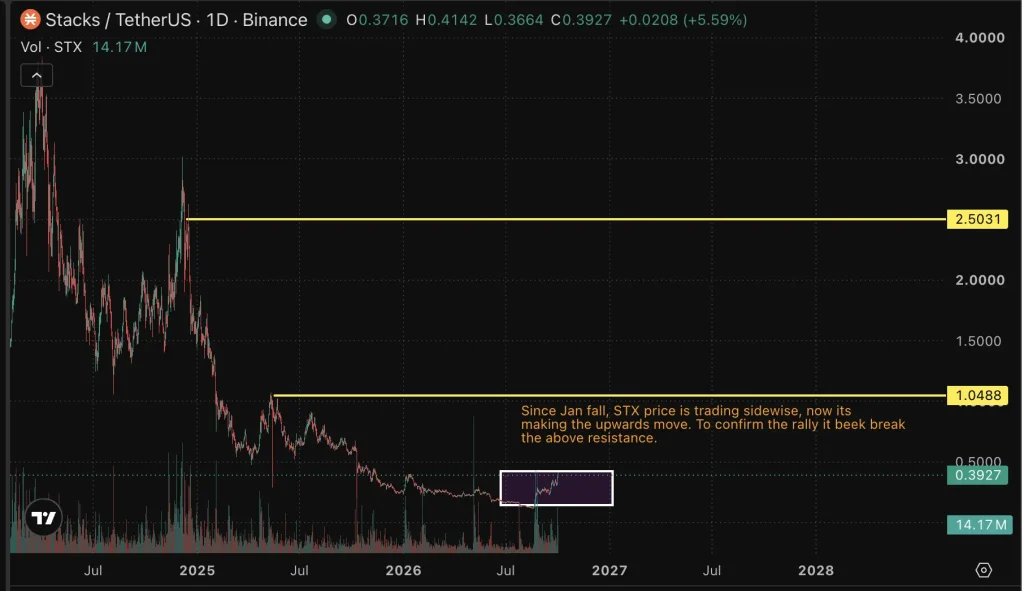
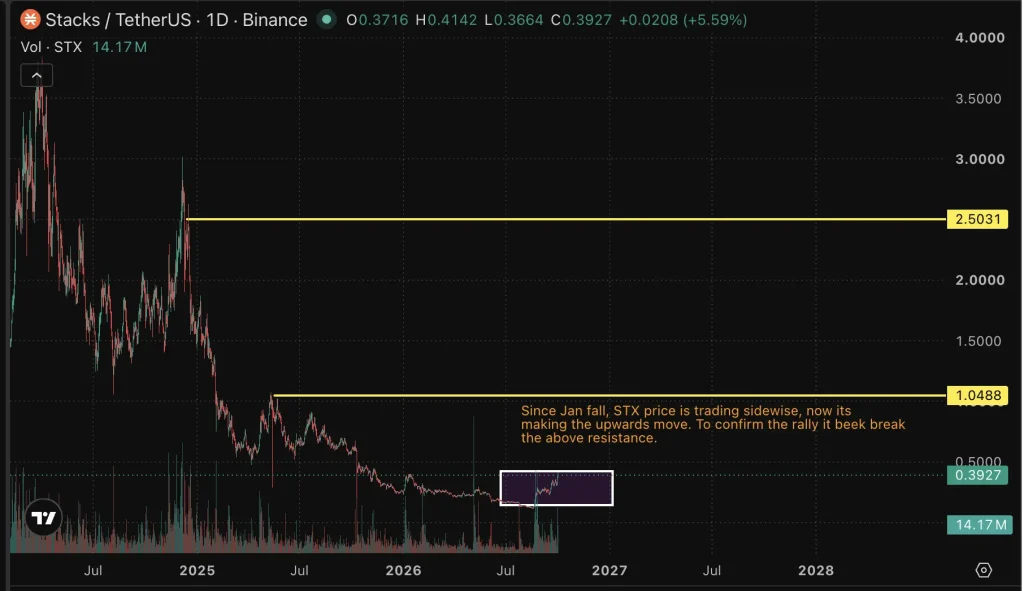
The first major resistance is $1.0488. A sustained breakout above this level would confirm a larger trend reversal and could open the path toward the next major target at $2.5031. However, STX would need to build momentum through several intermediate levels before reaching that target.
On the downside, the recent breakout zone around 0.30–0.32 becomes important support. Holding above this area would keep the recovery structure intact, while a return below it could signal another period of consolidation.
However, RSI is around 79, indicating the recent rally is becoming overbought and could face short-term profit-taking.
| Year | Potential Low ($) | Potential Average ($) | Potential High ($) |
| STX Price Prediction 2026 | $0.50 | $1.50 | $2.50 |
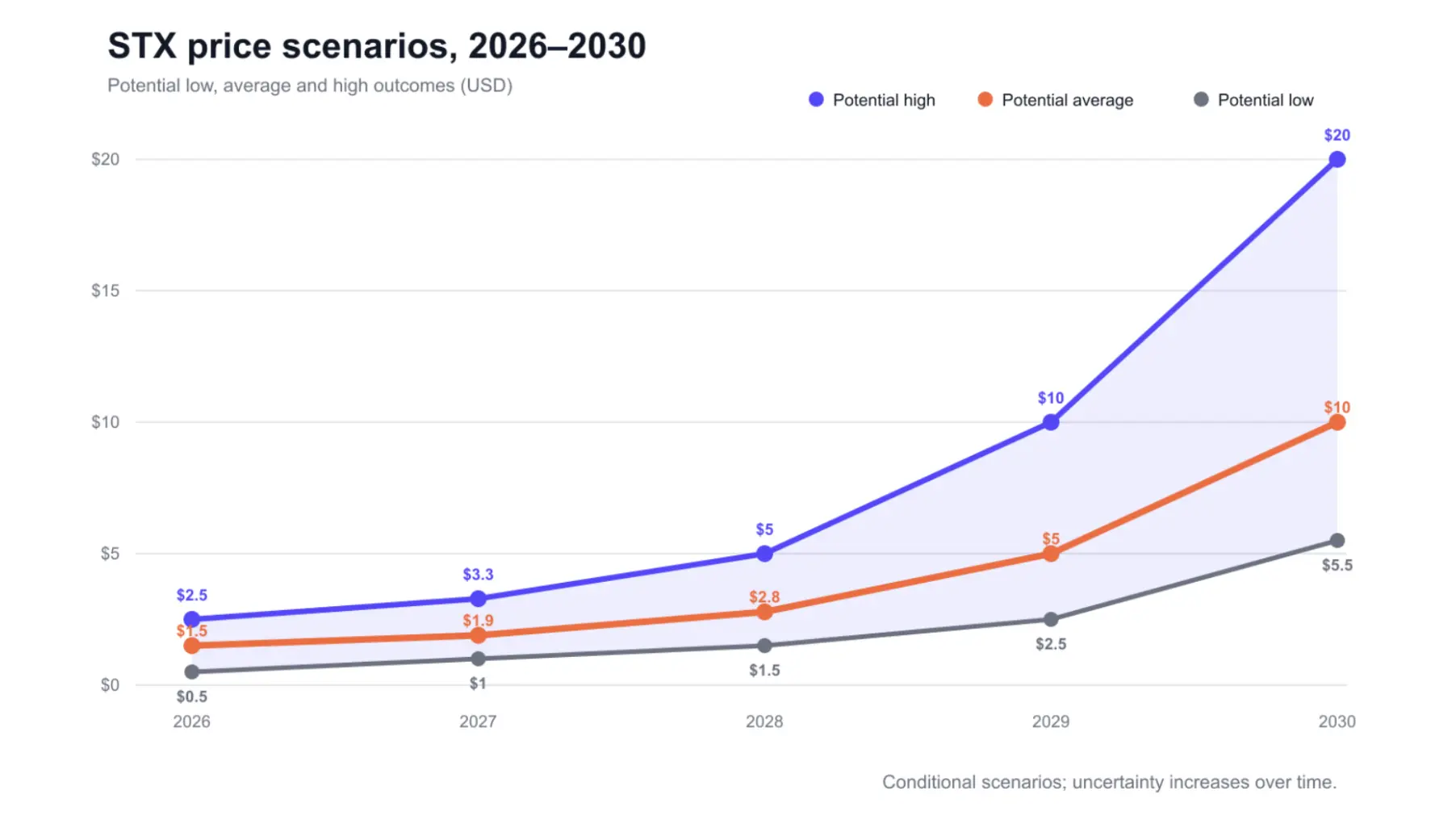
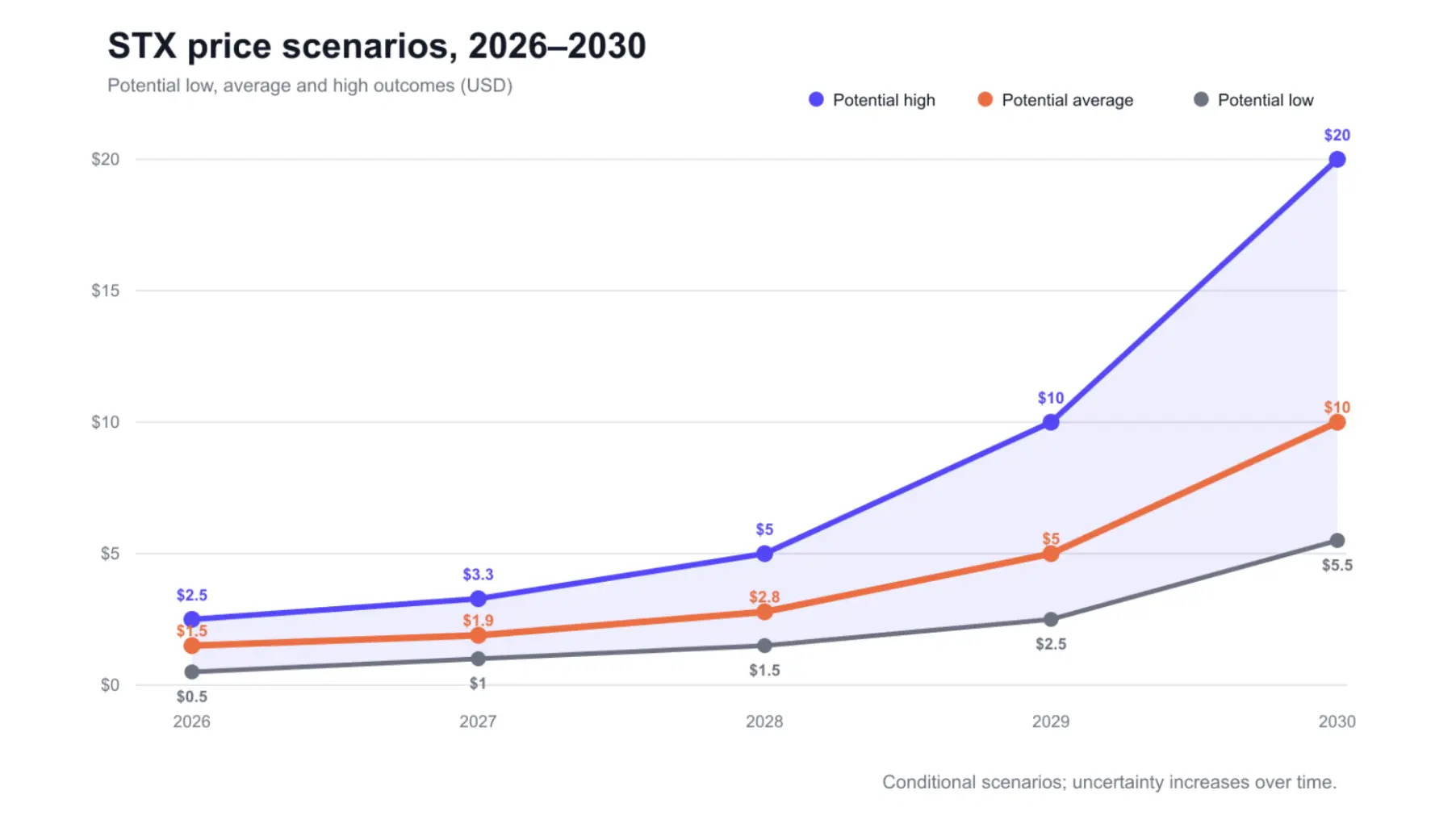
STX Crypto Price Prediction 2026 – 2030
| Year | Potential Low ($) | Potential Average ($ | Potential High ($) |
| 2026 | 0.50 | 1.50 | 2.50 |
| 2027 | 1.00 | 1.90 | 3.30 |
| 2028 | 1.50 | 2.80 | 5.00 |
| 2029 | 2.50 | 5.00 | 10.00 |
| 2030 | 5.50 | 10.00 | 20.00 |
STX Price Prediction 2026
The PoX-5 upgrade and institutional Genesis Bonds could bring significant Bitcoin staking capital to Stacks, pushing STX toward $2.50.
STX Price Prediction 2027
The Clarity WASM upgrade could boost transaction capacity and support wider DeFi adoption, potentially taking STX toward $3.30.
STX Price Prediction 2028
Growing Bitcoin Layer-2 adoption and a stronger crypto market could increase demand for Stacks, pushing STX toward $5.00.
STX Price Prediction 2029
Expanded sBTC bridges could attract more corporate capital and strengthen Stacks’ Bitcoin-based financial ecosystem, lifting STX toward $10.00.
STX Price Prediction 2030
A mature DeFi and lending ecosystem could strengthen Stacks’ role as a programmable Bitcoin layer, potentially driving STX toward $20.00.
STX Coin Price Prediction 2031, 2032, 2033, 2040, 2050
Based on the historical data and trend analysis of the cryptocurrency, along with market sentiment, here are the possible STX price targets for the longer time frames.
| Year | Potential Low ($) | Potential Average ($) | Potential High ($) |
| 2031 | 18.00 | 30.00 | 50.00 |
| 2032 | 35.00 | 50.00 | 70.00 |
| 2033 | 45.00 | 68.00 | 85.00 |
| 2040 | 80.00 | 100.00 | 120.00 |
| 2050 | 150.00 | 300.00 | 500.00 |
STX Price Prediction: Market Analysis?
| Year | 2026 | 2027 | 2030 |
| Changelly | $2.10 | $4.00 | $10.00 |
| DigitalCoinPrice | $3.00 | $4.80 | $11.00 |
| WalletInvestor | $2.00 | $3.70 | $8.00 |
What would need to happen for STX price to rise?
Through the rest of 2026: on the bonding side, mainnet activation for Bitcoin Staking, targeted for September, and the first institutions actually deploying BTC into it. On the gas side, continued growth past the current $86 million in Stacks DeFi TVL as the lending, stablecoin, and yield products building on top of it expand. The second one doesn’t depend entirely on the first. If Bitcoin Staking slips, gas demand from a growing Bitcoin-native finance layer is still a real, if slower, catalyst on its own.
By 2027: a full year of Bitcoin Staking live, with a meaningful and growing amount of BTC actually bonded into it, alongside a DeFi layer that’s grown enough to matter on transaction volume alone.
Toward 2030: both engines compounding together. Bonded BTC keeps growing, paired STX keeps getting locked up, and the resulting liquidity draws in more lending, trading, and yield activity that all needs STX for gas. STX has no hard supply cap, with base miner issuance and separate treasury emissions continuing over time, so this scenario also depends on demand from both drivers outrunning that ongoing issuance rather than just matching it.
Every one of those depends on adoption Stacks doesn’t fully control. That’s the honest version of this forecast: two mechanisms that work if people use them, one already running at small scale, one tested against a launch that hasn’t happened yet.
CoinPedia’s Stacks (STX) Price Prediction 2026
From CoinPedia’s perspective, Stacks (STX) could see gradual growth in 2026, supported by the PoX-5 upgrade, Bitcoin staking, and growing demand for Bitcoin-native finance.
The Genesis Bond could further strengthen STX utility by requiring participants to pair STX with bonded Bitcoin, potentially creating additional demand as institutional participation expands.
Thus, CoinPedia’s latest STX forecast places the 2026 price range between $0.50 and $2.50, with an average target of $1.50.
| Year | Potential Low ($) | Potential Average ($) | Potential High ($) |
| STX Price Prediction 2026 | $0.50 | $1.50 | $2.50 |
Never Miss a Beat in the Crypto World!
Stay ahead with breaking news, expert analysis, and real-time updates on the latest trends in Bitcoin, altcoins, DeFi, NFTs, and more.
FAQs
STX is the native token of Stacks, a Bitcoin layer built for Bitcoin-native finance. Most Layer 2 tokens mainly pay gas. STX has three jobs: it pays transaction fees on Stacks, it can be locked to earn BTC-denominated rewards through Proof of Transfer, and it’s set to become the required bonding asset for Bitcoin Staking.
Two things. Stacks’ proposed Bitcoin Staking product requires BTC holders to pair their bonded Bitcoin with STX worth roughly 5% of the position, tying STX demand to actual BTC participation. Separately, STX is the gas asset for Bitcoin-native finance on Stacks, so growth in protocols like Zest Protocol and USDCx liquidity creates transaction demand that doesn’t depend on Bitcoin Staking’s launch date. Market conditions remain an additional variable. After reclaiming the $0.20 area in August, the next important technical levels are around $0.30 and the broader $0.38 to $0.50 region.
STX tends to make larger price moves than Bitcoin in both directions. Its price remains sensitive to the broader Bitcoin cycle, but it also reflects expectations around activity on Stacks. That combination can amplify upside when Bitcoin conditions and Stacks adoption improve, while also producing deeper losses when market sentiment weakens.
Stacks (STX) is expected to trade between $0.50 and $2.50 in 2026, depending on Bitcoin trends, adoption growth, and overall crypto market conditions.
A $5 STX price would represent a substantially stronger expansion than the near-term 2026 scenarios. Under the forecast framework above, $5 appears as the potential high scenario for 2028. Reaching that level would likely require several years of favorable market conditions alongside significant growth in Stacks adoption, Bitcoin Staking participation and demand for STX.
Has Bitcoin Staking launched? Not yet. Mainnet activation is set for September 10, 2026. More detail is available on Stacks’ institutional Bitcoin Staking page.
That both halves are earlier than the bullish case suggests. Bitcoin Staking’s bonding demand only shows up if BTC holders actually use it after mainnet, and the ecosystem meant to absorb that capital remains relatively small. The two aren’t fully independent either: a slow Bitcoin Staking launch likely means slower ecosystem growth too. Broader crypto market conditions remain another major variable because STX’s higher volatility can amplify both gains and losses.