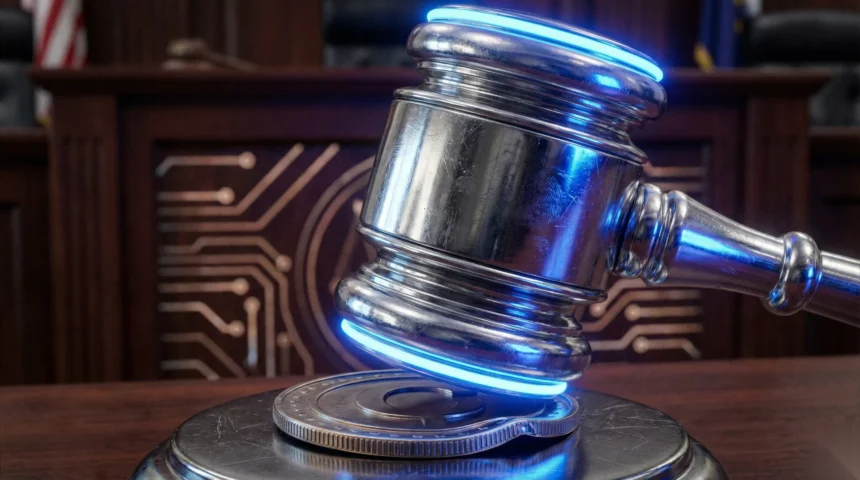
Justin Sun, the founder of the Tron blockchain, filed a lawsuit against World Liberty Financial, backed by Donald Trump’s family, alleging that it unfairly blocked $45 million worth of $WLFI tokens, made deceptive statements, and tried to damage his reputation. Justin Sun, a leading cryptocurrency entrepreneur of Asian origin, is particularly known for his contributions to the decentralized finance (DeFi) ecosystem. World Liberty, on the other hand, draws attention by stating that it operates in the decentralized finance sector and receiving the support of family members of US political figures.
Details of the case and main allegations
In the lawsuit filed on Tuesday, Sun stated that the World Liberty team invited him to invest in the new project, and in this context, he bought the $WLFI token for $ 45 million in 2024. According to the case file, World Liberty management demanded that Sun make new investments by 2025 and also produce the company’s stablecoin called USD1. When Sun did not respond positively to these demands, relations with company executives became tense.
The file claims that World Liberty persuaded investors to buy tokens with misleading and incomplete information. It is claimed that the company’s public statements regarding the economic rights and governance powers it promised to $WLFI owners do not reflect reality. However, the lawsuit also highlights that although World Liberty is decentralized, it centralizes token control.
Another noteworthy claim in Sun’s complaint is that World Liberty added a “blacklist” function to the smart contract that manages $WLFI in August 2025. This change was buried in the codes without being submitted to investors for approval and made public. With this method, tokens in certain wallets can be frozen and transactions are prevented.
Allegations of market manipulation and oppression
According to Sun, the purpose of freezing the company’s tokens is twofold: to pressure Sun to mint $200 million of the company’s stablecoin on the Tron blockchain and to keep the price artificially high in the $WLFI market. By preventing a large investor like Sun from selling, the value of World Liberty founders and the tokens in the company’s vault were protected.
“While the company kept the technical change in the blockchain secret for everyone to see, it added a blacklisting function in the code and did not disclose its existence or consequences to any investors,” the statement was included in the case file.
In addition, World Liberty’s authority to issue tokens, freeze them, and transfer them to other wallets at will has called into question the company’s decentralization claims and also created a regulatory risk in the United States. The complaint notes that these powers could subject World Liberty to FinCEN rules as a money transfer provider.
According to the lawsuit, Chase Herro, a member of World Liberty’s executive team, publicly made two threats to Sun. In one of them, he warned that they would burn Sun’s $WLFI tokens unless he requested it, and in the other, he claimed that Sun and his companies had insufficient identity verification documents and warned to report them to US authorities.
Privacy, past relationships and reactions
Portions of Sun’s case have been crossed out; In an additional petition, the World Liberty team was given the right to decide whether these confidential articles should remain confidential. “I tried to resolve the situation in good faith. I just want to be treated the same as other early investors; nothing more, nothing less,” Sun said on social media, underlining his demand for equality.
Sun also emphasized that he is absolutely against the new governance proposal announced by World Liberty on April 15.
In the statement made on behalf of World Liberty after the case, it was stated that there would be no comment on the issue. On the other hand, Sun has been to the USA more frequently lately. He was even invited to Trump’s first memecoin dinner last year. Sun also settled a previous lawsuit with the U.S. Securities and Exchange Commission last month, paying $10 million.