
The 401(k) system in the United States is an employer-sponsored retirement plan that allows private sector employees to save tax-advantaged for retirement. With Trump taking office, access to cryptocurrencies was opened here as well. Especially the step taken at the end of March excited crypto investors. So what exactly is a 401k? What is the asset size? to cryptocurrencies How many potential inflows can there be?
What is a 401k?
We can say that the equivalent of this in Türkiye is the Private Pension System (BES), especially the Automatic Participation System (OKS), where automatic deductions are made from the salary. In fact, the new system in Türkiye is similar to 401k because the Automatic Enrollment System (OKS), in which employees under the age of 45 are included by deducting 3% from their salaries, has been expanded.
In America, your employer makes payments on your behalf by “matching” up to a certain percentage of the amount you deposit. In Türkiye, there is State Contribution instead of employer contribution.
There are 2 types of 401ks. In the first, contributions are made from gross salary (before tax). Income tax is payable when money is withdrawn. In a Roth 401(k), contributions are made from net salary with taxes paid. Amounts withdrawn in retirement (including earnings) are tax-free.
How big is a 401k?
It is expressed in trillions of dollars. As of April 2026 US 401(k) market size and the most up-to-date data on asset allocation is published by the Investment Company Institute (ICI). Total US retirement assets are over $49 trillion. Assets in 401(k) plans alone surpassed the $10 trillion threshold for the first time in history, at $10.1 trillion. Tens of millions of active employees are participants.
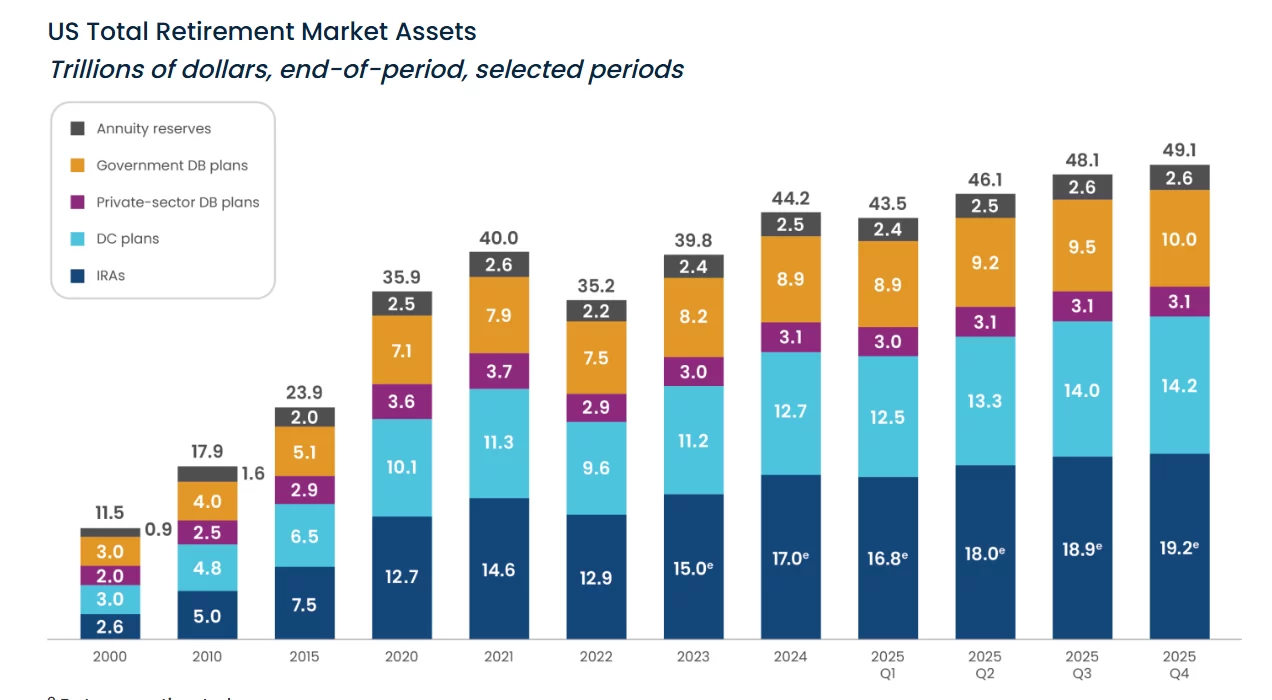

The breakdown of where the $10.1 trillion in 401(k) plans is invested is as follows;
- Mutual Funds 57% (5.8 trillion)
- Equity Funds 33% (3.4 trillion)
- Mixed/Target Date Funds 15% (1.6 trillion)
- Bonds and Cash Equivalent Assets around 10% (1 trillion)
This distribution is variable. However, the emphasis is on mutual funds.
potential
401(k) assets, which reached $10.1 trillion by the end of 2025, are expected to continue growing this year due to the impact of a number of new legal regulations and economic factors. Cerulli Associates and ICI forecast average annual growth of 7-9%. Based on $10.1 trillion at the end of 2025, it wouldn’t be surprising if the market reached 2027.
401k and Cryptocurrencies
DOL (US Department of Labor), cryptocurrency for 401(k) and facilitating capital access for two industries rule announced. In August last year, Trump wanted retirement plans to have easier access to alternative assets such as crypto and real estate, and issued a presidential order to this effect.
US Secretary of Labor Lori Chavez-DeRemer said;
“Our goal is to deliver on President Trump’s promise of a new golden age by promoting a retirement system that enables more Americans to retire with dignity.
This proposed rule would demonstrate how plans can consider products that better reflect today’s investment environment. “This greater diversity will spur innovation and provide huge benefits for American workers, retirees and their families.”
The rule was officially published under the title “Fiduciary Duties in Selecting Designated Investment Alternatives”. By providing “Safe Harbor” protection to 401(k) plan managers; cryptocurrencyThe freedom to include assets such as private equity and real estate in retirement funds is provided. This protection is in place to keep them away from possible lawsuits from their customers. However, they must comply with 6 rules, that is, they cannot invest in every cryptocurrency or crypto fund as they wish and avoid the lawsuit.
- Performance: The risk-adjusted expected return of the asset should be evaluated from a long-term perspective.
- Fees: It is enough for the fees to be “affordable”; The obligation to choose the lowest-priced option has been removed.
- Liquidity: Must have sufficient cash flow to meet participants’ withdrawal needs.
- Valuation: There must be reliable mechanisms to determine the price of the asset accurately and on time.
- Benchmarking: The performance of the asset should be compared with a meaningful indicator with a similar risk profile.
- Competence: The plan administrator must have the knowledge and competence (or counsel) to understand the complexity of the asset he or she selects.
This step shows that we are going in the opposite direction of the warnings about “extreme caution in crypto investments” during the Biden era (which were canceled in May 2025). The Trump administration aims to ensure that retirement funds are not limited to stocks and bonds, and that individual employees also have access to the variety of “alternative assets” that institutional investors have.
If we see even 1% flow into crypto in the current $10.1 trillion 401(k) market with the latest incentives, that would be $101 billion. This alone is last year’s crypto ETF well above their entrance. Since it is clear that not all companies will offer this option at the same time, even if we reduce 1%, it would not be surprising to see an annual inflow of 25 to 45 billion dollars into the market within 12-18 months. Just as spot ETFs were not widely offered by asset managers in the first place, and the likes of Vanguard saw it as nonsense in the day (they later abandoned it), the process for 401ks will be similar.
The biggest advantage of 401k entries is the fact that a significant portion of these investors do not sell their assets in the long term. In other words, inflows from here will significantly narrow the sales supply in the market and support spot markets.