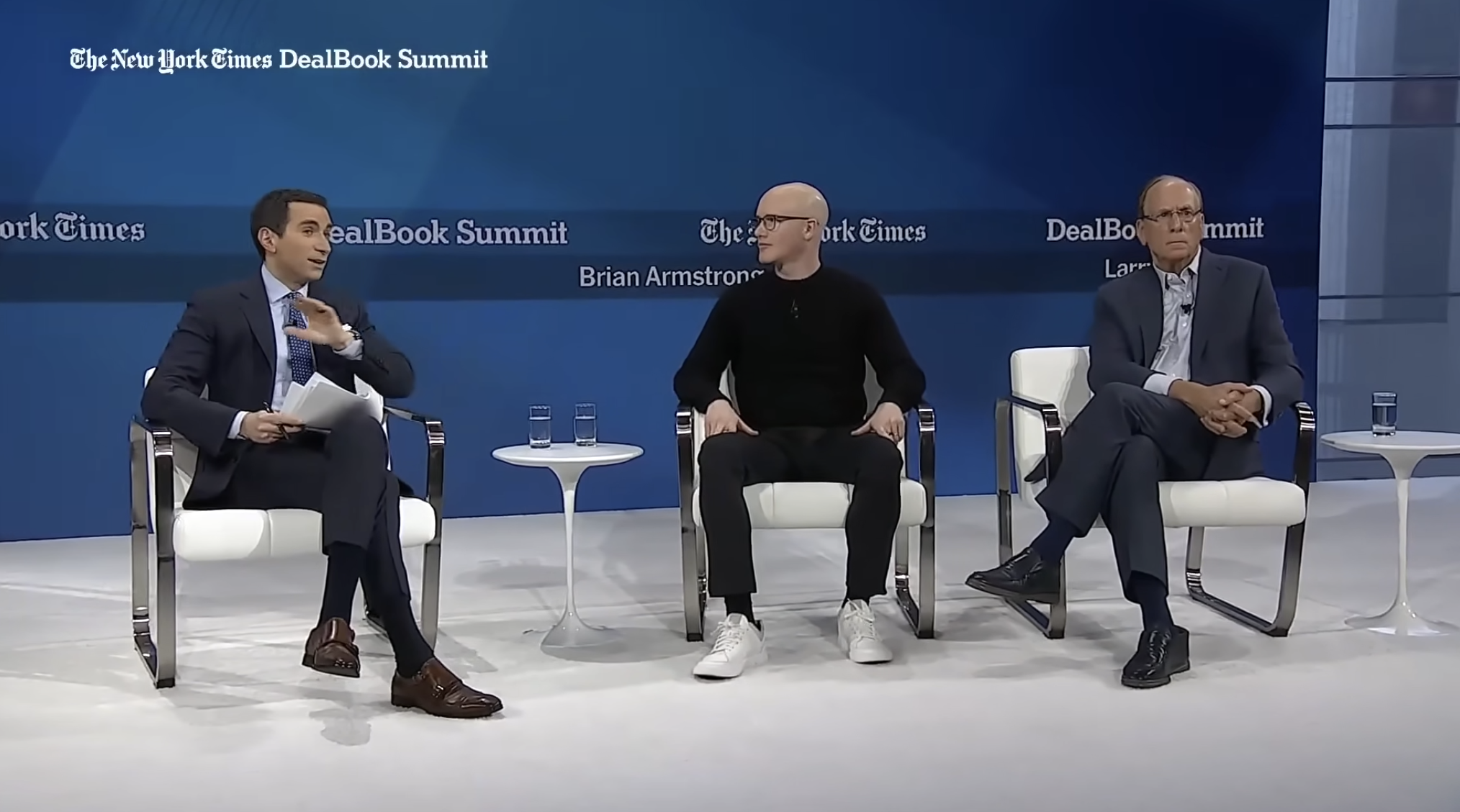
The crypto world went through an important turning point at the DealBook Summit held in New York. Coinbase CEO Brian Armstrong and BlackRock CEO Larry Fink discussed Bitcoin, which has been a subject of discussion for many years.  $86,989.86shared their future vision by discussing the place of stablecoins and tokenization technology in the global financial system. Although the two names spoke from different perspectives, they met on a common point: Crypto is no longer outside the system, but a financial structure that is rapidly moving into it.
Armstrong and Fink Discuss Crypto’s Changing Role Towards 2026
Larry Fink, who manages BlackRock’s giant Bitcoin ETF, said that he had radically changed his view, recalling that he described Bitcoin as a “thieves’ currency” years ago. He stated that he saw Bitcoin as a long-term store of value as he took a closer look at the issue during the pandemic period. According to Fink, Bitcoin has become an “asset of fear” today; In other words, it is a port used by the masses who are concerned about economic or physical security.
Brian Armstrong, on the other hand, firmly rejected the views that Bitcoin will go to zero and emphasized that crypto has now created an irreversible structural transformation. According to him, traditional investors and older generations have difficulty accepting a more decentralized system born into the internet because they grew up in a dollar-centered world.
2025 Will Be the Year of Crypto Regulation Breaking in the USA
Both men think that 2025 will be decisive in terms of crypto policies in the USA. Armstrong said that the passage of the Genius Act, which regulates stablecoins, and the bills that determine the framework of the crypto market, by Congress means “a transition from the gray market to a bright era.”

Armstrong also defended Coinbase’s political spending of more than $50 million. In his opinion, while there are still no clear rules for crypto, which is used by 52 million Americans, it is a natural step for companies to try to influence politics “to protect the consumer.”
Larry Fink, on the other hand, stated that BlackRock shares its political expenses equally between the two parties, and stated that it is a great risk for the company if any step is perceived as “purchasing interests”.
While these discussions were taking place, there were also important developments in the international arena. Last week, the European Central Bank announced that it was entering a new pilot phase in its digital euro studies. It was announced that in the first tests conducted with the digital euro, the payment speed decreased to seconds. This development was interpreted as the USA may fall further behind in the digital currency race.
The Tokenization Race and Banks’ Forced Peace with Crypto
According to Larry Fink, the real big transformation will not be Bitcoin, but the digitalization of all assets. Tokenization of everything from bonds to real estate; It will reduce costs, accelerate transactions and expand the investor base.
Armstrong, on the other hand, spoke more harshly, claiming that banks were trying to block stablecoins, but this was only done to protect their own profit margins. According to him, in a year or two, banks will turn into institutions that “lobby to give interest on stablecoins.”
Reminding that Coinbase started stablecoin and custody pilot applications with major banks today, Armstrong announced that more than 80 percent of crypto ETFs use the Coinbase infrastructure.
Fink, who thinks that the USA is left behind in this transformation, stated that India and Brazil are further ahead than the USA in digital finance infrastructure. The speed of these countries in real-time payments and digital money applications brings global competition to a critical point.
As a result, the process of crypto integration with the global financial system is now seen as an inevitable reality. Armstrong and Fink’s different perspectives show that the industry is on a journey that is both full of opportunities and surrounded by uncertainties. It is critical for major economies, especially the USA, to keep up with this technological transformation, not only in terms of financial competitiveness, but also in terms of economic security and consumer interests.