
Trump makes a statement and a few hours later, Iran denies it. This is what we have seen since the war began. So what is the latest situation on the Iranian front? What do QCP Capital analysts say about quantum, which is on the agenda of cryptocurrencies? Let’s take a quick look.
Iran rejected fire
In the past few days, it was said that there might be a 1-month ceasefire with Iran, but Iran denied this. trumpHe said that they were negotiating with the Speaker of the Iranian Parliament (the head of the new regime), but this name also said that there was no regime change and no meeting. Today Trump said “they asked us for a ceasefire” and Iranian He denied this too.
Extremely frivolous statements cause markets to become insensitive to high-level statements. Trump’s coming to office destroyed the credibility of the USA with tariffs and similar issues. Now Trump is talking about leaving NATO.
Spokesperson of the Iranian Ministry of Foreign Affairs;
“Trump’s claims that we requested a ceasefire are false.” – Al Jazeera
Today it was announced by TASS that Iran may accept Russia as a mediator, and yesterday the Iranian President said the war could end trump And of Iran We can think that he is lying to a certain extent. So, although there is hope for talks and a ceasefire, Trump exaggerates this and Iran probably denies it.
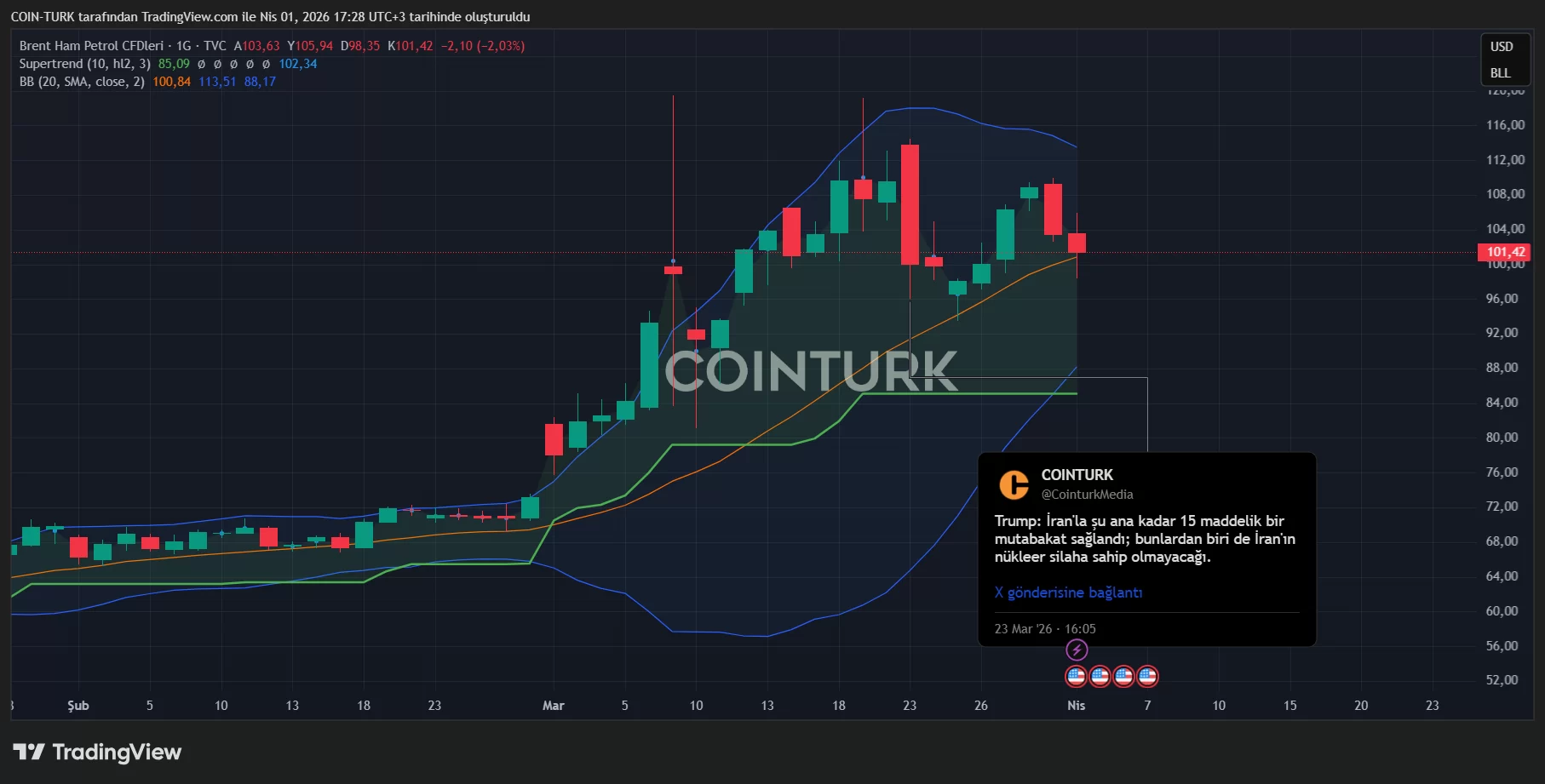

When we look at the oil chart to see how the market reacted to the statements, it is clear that the sentiment has shifted to positive compared to the beginning of the week. This stems from Iran’s gradual approach to a ceasefire (Pezeshkian’s statement, statements like Russia should be a mediator, etc.).
QCP: Risk for quantum crypto
Yesterday, we discussed topics such as what quantum is and what its risks are. Today, QCP analysts clarified the critical issue that is on the agenda. Yesterday’s Google article fueled concerns about elliptic curve cryptography (ECC) used in Bitcoin and Ethereum. QCP analysts say this does not pose an “immediate risk” but is a long-term structural problem.
“At the core of ECC security is the Elliptic Curve Discrete Logarithm Problem (ECDLP-256). This protects private keys and makes deriving them from public keys computationally impossible. However, this same standard also secures banking networks, encrypted communications, and global financial infrastructure, including systems such as SWIFT. Therefore, a breakthrough in quantum computing that would compromise ECC would put all digital finance, not just cryptocurrencies, at risk.” – QCP
That’s why Google said that preparations should be made until 2029, and as the algorithms develop, the deadline comes forward. Even if Google’s computing power reaches a level that can break this, the risk will start after 3 years as it gives the world until 2029.
“From a technological perspective, we are still quite far from the computational power required to break this standard. Google’s paper suggests that fewer quantum resources may be needed than previously thought, estimating that ~1,200 to 1,450 logical quantum bits may be needed to break ECDLP-256. This translates into approximately 500,000 to 1.2 million physical quantum bits, depending on assumptions.”
To date, the world’s most advanced quantum systems operate at a fraction of this scale; “This leaves us approximately 1,000 times below the threshold required for a practical attack.”
Since the risk is already known, QCP analysts say that both crypto and traditional finance will take the necessary precautions, meaning the risks will be eliminated.
“Our view is clear. Quantum computing is a long-term issue for the industry to monitor and prepare for; it is not a near-term reason to re-evaluate digital assets. Current headlines are ahead of reality.”
No quantum system today can perform this attack on a large scale. “When the issue comes to the fore, this will not be a cryptocurrency-specific event but a coordinated, system-wide transition across the entire digital infrastructure.”