
While everyone was focusing on the Strait of Hormuz, European officials made a statement about the Houthis at the time the article was being prepared. We know how the Houthis in Yemen blocked the Red Sea before. If the Europeans are right, cryptocurrencies could be painted red again.
Houthis and Cryptocurrencies
European officials, in their statements at the time of writing, said that the next problem would be the Houthis. Officials say Iran is pressuring its proxies in Yemen to suppress shipping, and they think the Red Sea may be closed. The Houthis had already done this and announced that they could do it again (if there were attacks on Iran’s critical facilities).
Houthis (Ansarullah movement) is a power with extremely strong relations with Iran. Beyond the sectarian alliance, they are seen as Iran’s proxy power in the region (like Hashd al-Shaabi in Syria). Houthi military spokesman Yahya Saree and leader Abdul Malik al-Houthi frequently make statements supporting Iran.
The Red Sea is the main artery through which 12% to 15% of global trade passes. In other words, if it closes, it will have negative consequences on markets such as the Strait of Hormuz. Since this is not something that has been priced before in cryptocurrencies causes a decline. Approximately 30% of the world’s container traffic normally uses this route. In case of full closure, all of this traffic would shift to the Cape of Good Hope. This effectively results in a contraction of around 10-15% in global ship capacity (as the route gets longer).

Approximately 10-12% of global seaborne oil (7-8 million barrels per day) passes through this route. There may be an instant supply delay of 15-20% in processed products such as diesel and jet fuel that Europe buys from the Middle East. Spherical LNG Approximately 8-10% of its trade passes through here.
Since 15-35% of the supply, from automotive parts to semiconductors, grain and textile ready-to-wear, passes through here, our risk of seeing inflation due to supply contraction in many items increases.

For example fertilizer and 12% of chemicals pass through here. Giant producers such as Russia, Belarus and Morocco reach Asia, and Asian producers reach Europe. Hormuz also hosts 33% of the supply, and almost half of the supply will be cut off with byproducts. This situation alone will increase global food inflation. Here we will monitor the risk situation from the Container Freight Index.
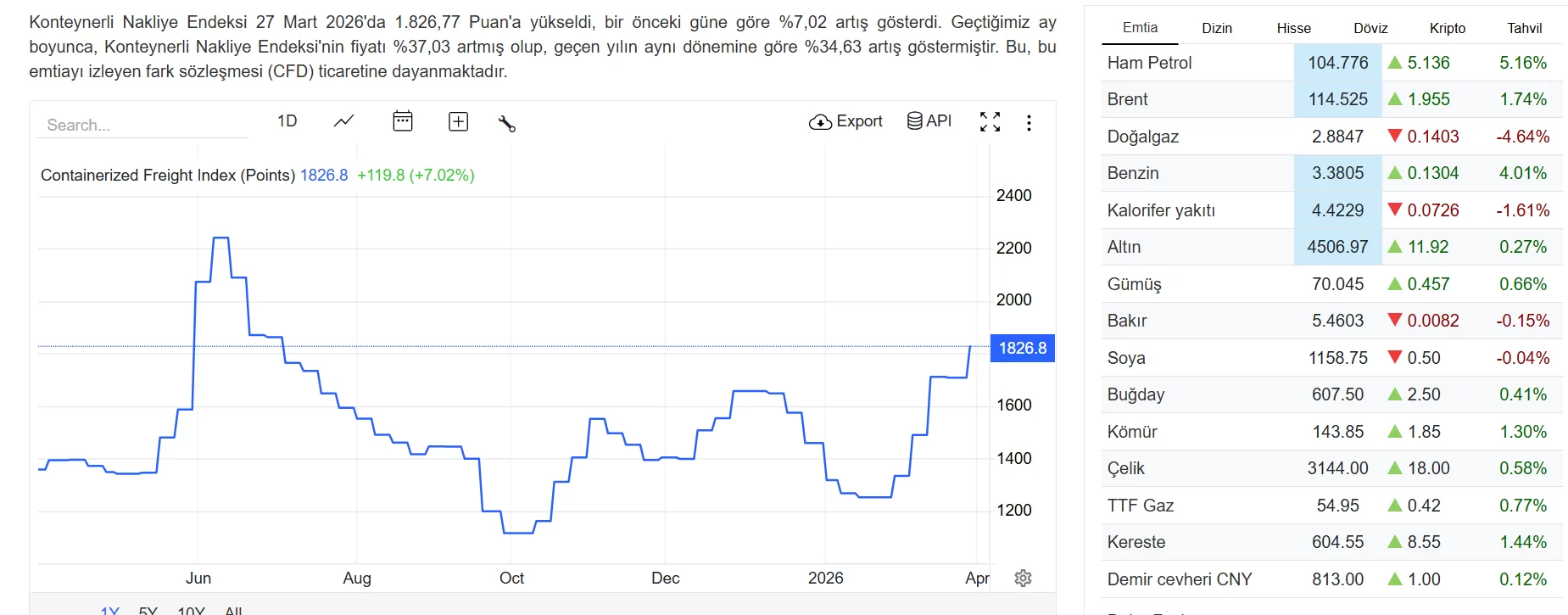
In summary, this scenario will have very bad consequences for cryptocurrencies.
Fed Statements
Fed’s His second name, NY Fed President Williams, is making statements at the time of writing. Accepting that geopolitical developments in the Middle East create serious uncertainty on economic activities, Williams mentioned that energy prices are pushing inflation up.
“As measured by the Personal Consumption Expenditures (PCE) price index, inflation is currently running around 3 percent, with customs duties adding 0.5 to 0.75 percentage points to this figure. Additionally, the significant rise in energy prices driven by developments in the Middle East is likely to increase overall inflation in the coming months; however, assuming oil prices fall following the end of hostilities, these effects are expected to partially reverse later in the year.”
Uncertainty about the future course of inflation is high. Conflict in the Middle East could lead to a major supply shock that would have significant effects on weakening economic activity while increasing inflation through increases in intermediate costs and commodity prices. This situation has already begun to emerge. Until recently, data did not indicate significant supply chain bottlenecks, but supply chain disruptions are now evident in the supply of energy and related goods.
The lasting effects of tariffs and higher energy prices will increase headline inflation in the short term. However, there are still some positive trends. There are no signs of significant knock-on effects from the spread of tariffs to the rest of the economy, and the labor market is not contributing to inflationary pressures. Core inflation, excluding imported goods, is trending in the right direction. And importantly, most surveys and market-based indicators of long-term inflation expectations, including the New York Fed’s Survey of Consumer Expectations, are at levels consistent with the FOMC’s 2 percent target.
We are going through an unusual period for the economy. Significant risks exist and uncertainty is high; especially regarding the economic effects of the Middle East conflict.
I am determined to support maximum employment and return inflation sustainably to our long-term target of 2%. “When assessing the future course of monetary policy, my views will, as always, be based on the development of all data, the economic outlook and the balance of risks to achieving our goals of maximum employment and price stability.”
The fact that he can raise alarms on the employment front even in this environment shows that Williams has not given up on interest rate cuts.