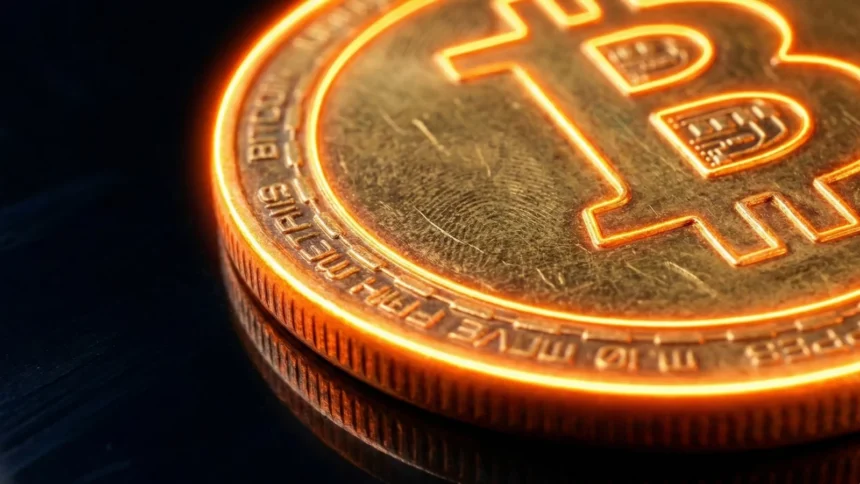
According to the report titled “Superpositioned: The Quantum Decade Ahead” prepared by industry analyst Saneel Sreeni, there have been historic developments in the field of quantum computing in the last eleven months. With the successive innovations announced by three important companies, the level of accuracy and fault tolerance achieved by quantum computers in commercial systems has raised the bar. Quantinuum achieved the highest two-qubit gate accuracy rate ever measured with its Helios processor. Google, on the other hand, proved the theory in its Willow chip that more qubits increase reliability in the system. Microsoft used a new class of defect-resistant materials in the chip called Majorana 1.
Quantum Threat and Security of Bitcoin
Bitcoin’s security is based on elliptic curve cryptography. Here, users prove their ownership with the private key, which is a large secret number, while the public key visible in the chain can only be derived from this private key. On classical computers, backcalculating this private key is practically impossible. However, if a sufficiently powerful quantum computer and Shor’s algorithm come into play, this assumption may become invalid.
Large Assets and Cryptography Breakage Risk
According to current research, quantum computers capable of reaching sufficient power could put approximately 7 million Bitcoins at risk. Among these, there is a section of approximately 1 million belonging to Satoshi Nakamoto, who first developed the network. Risk varies depending on address types; While in old addresses public keys appear instantly in the chain, in some modern addresses this transparency is revealed by movement. The keys of users sending via an address are already in the blockchain, opening the door to potential attacks in the future.
Experts state that the future of Bitcoin is not a concern for tomorrow, and that the main risk lies in timing asymmetry. While updates to distributed structures like Bitcoin take many years to coordinate, progress in quantum hardware does not follow a linear course. So if quantum technology catches up earlier than predicted, potential damage could occur before patches.
Resilience in the Quantum Age: Technical and Political Barriers
The US National Institute of Standards and Technology has published three new crypto standards that are resistant to quantum attacks, and BTQ Technologies has accordingly developed a system that converts the Bitcoin signature into the ML-DSA standard. But Bitcoin’s real challenge is governance-based rather than technical. Updates that require a global social consensus are considered highly sensitive in the decentralized network structure. No entity on the network is discriminated against based on wallet age, identity or future risk. Advocates of the protocol’s neutrality and irrevocability argue that creating exceptions could set a dangerous precedent.
Michael Saylor, chairman of the board of directors at Strategy, states that quantum risk is at least ten years away and states that the cyber security community also shares this view. He adds that the quantum threat will be reflected not only in Bitcoin but also in all digital systems such as banks, governments and artificial intelligence networks.
Steps and General Table
Today, the steps that average users can take seem concrete and feasible: Transitioning from old type addresses to new types, closely monitoring the 2028–2030 period and supporting post-quantum updates are among the measures to be taken. Using a hardware wallet, paying attention to cold storage and address hygiene are also methods that increase security.
As noted in the “Superpositioned” report, advances in the quantum field trigger each other in a chain: Better qubits enable material simulation, which enables more advanced qubits; Business income spirals into investment and progress. The convergence of quantum hardware and artificial intelligence fields indicates a faster process than expected in recent years.