
The cryptocurrency market revealed a picture that went beyond the usual patterns in the 2025 cycle. The strong rises experienced after Bitcoin halvings in the past did not have the expected effect this time. While Bitcoin closed the year with a decline of approximately 6 percent, the weakness on the altcoin front became even more evident. TOTAL3 data, which represents the market value excluding Bitcoin and Ethereum, shows that altcoins closed with a loss against Bitcoin for the fourth consecutive year. This situation has been discussed for a long time, “Is the altcoin season over?” brought the question back to the agenda.
Why Has Bitcoin Dominance Become So Strong?
Looking at technical data, it seems that Bitcoin’s influence on the market is systematically increasing. While Bitcoin dominance (BTC.D) was around 40 percent in 2022, it increased to over 60 percent by 2025. This increase means an additional contribution of approximately $900 billion to Bitcoin’s market value. While the total crypto market value increased to 1.11 trillion dollars in the same period, it is noteworthy that approximately 80 percent of the newly entered capital turned to Bitcoin.
This chart shows that investors avoid risk in times of uncertainty and prefer Bitcoin, which is seen as a safer haven. As a matter of fact, the increase in institutional interest in spot Bitcoin ETFs in the USA in 2025 stood out as another important development supporting this trend. The movement of large funds directly into Bitcoin has become one of the main factors limiting the liquidity going to altcoins.
Changing Dynamics in the Altcoin Market
In hindsight, the 2021 cycle offered a classic example of an altcoin season. While Bitcoin’s market value increased by 64 percent that year, TOTAL3 increased by an extraordinary 541 percent. Capital quickly flowed out of Bitcoin and into the broader altcoin market, and the Altcoin Season Index peaked. However, this structure was not sustainable.
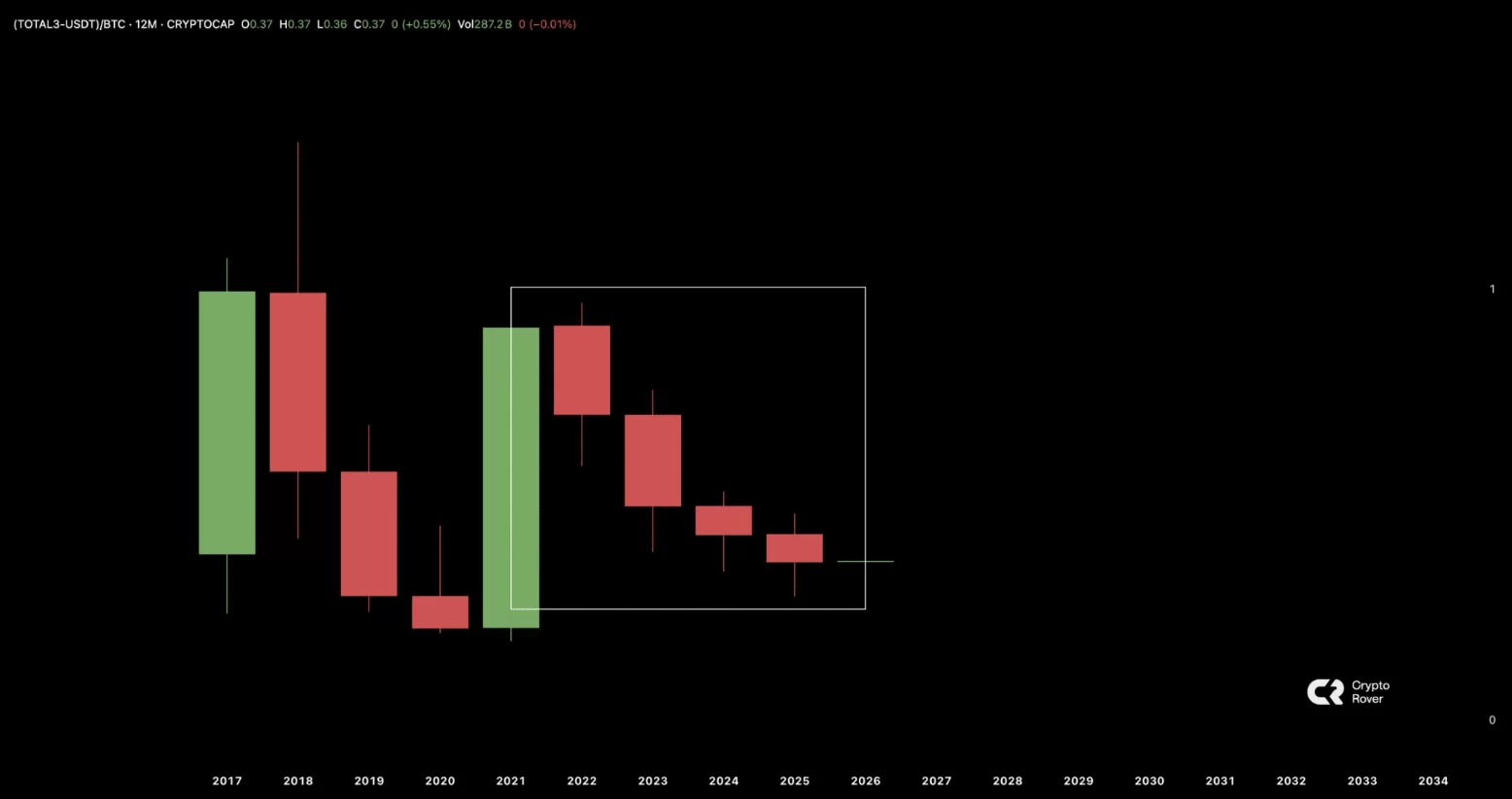
The sharp rise in altcoin funding rates in recent years has led to the accumulation of overleveraged long positions in the market. Although this situation may seem like a bullish signal at first glance, it has actually dragged altcoins into an extremely fragile structure. Even horizontal or limited price movements can trigger chain liquidations. In addition, increasing Bitcoin dominance makes altcoins more susceptible to sharp fluctuations.
Another recent news that supports this picture is that some major exchanges reduced the leverage limits in altcoin futures transactions. Stock exchanges took this step, citing excessive volatility and investor risks. This development is interpreted as an important signal indicating that the old period of aggressive growth in the altcoin market is behind.
In conclusion, the divergence between Bitcoin and altcoins is not accidental; On the contrary, it shows that the market has changed structurally. A repeat of a large-scale and long-lasting altcoin season like the one in 2021 looks increasingly difficult under current conditions. It is critical for investors to read this new period correctly in terms of placing expectations on realistic grounds.