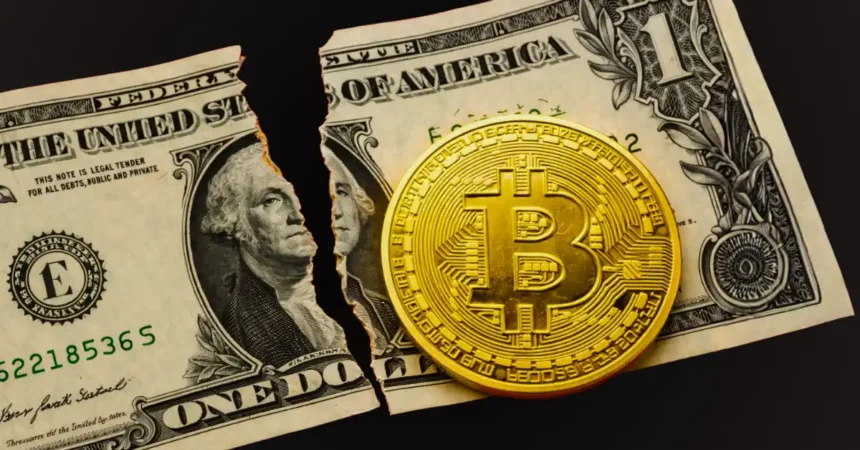
Bitcoin has long been seen as a hedge against the US dollar. But Coinbase CEO Brian Armstrong is making a different case – one that’s gaining attention as America’s debt problem keeps growing.
Armstrong believes Bitcoin is not a threat to the dollar. Instead, he says it may actually help keep it strong.
“Bitcoin is good for USD,” Armstrong said, arguing that Bitcoin creates healthy competition that pressures governments to stay disciplined.
Bitcoin as a Pressure Valve for the Dollar
According to Armstrong, Bitcoin acts as a financial escape hatch when trust in government policy starts to weaken.
“Bitcoin provides a check and balance on the dollar in the sense of, if there’s too much deficit spending or inflation in the US, people will flee to Bitcoin in times of uncertainty,” he said.
That possibility, he argues, forces policymakers to think twice before letting inflation spiral. Armstrong warned that if inflation continues to outpace economic growth, the US could eventually lose its reserve currency status – something he described as “a massive blow” to the country.
“It might be okay to have 2-3% inflation if the economy is growing at 2-3%,” he said. “But if inflation outstrips the growth of the economy, you’ll eventually lose the reserve currency status.”
- Also Read :
- Why Were Coinbase and Gemini Blocked in the Philippines?
- ,
Why This Argument Now?
US national debt has climbed to about $37.65 trillion and is growing by more than $70,000 every second. Earlier this year, interest payments on that debt surpassed the country’s entire defense budget.
Armstrong has pointed to these numbers as proof that current incentives don’t encourage balanced budgets. He has also supported efforts to modernize government operations, saying technology could help reduce waste and improve efficiency.
Crypto Community Reacts
Armstrong’s comments quickly sparked discussion online.
Many users agreed with his framing, with one popular reaction stating, “Competition creates accountability. Bitcoin is the check. Inflation is the problem.”
Others weren’t convinced. Some pushed back, saying the perspective doesn’t address the dollar’s intrinsic value.
Bitcoin’s Role Is Changing
The idea that Bitcoin could support the dollar, rather than replace it, is gaining ground. Senator Cynthia Lummis has said Bitcoin could strengthen the US financial position, while Strategy’s Michael Saylor has framed it as digital capital for national balance sheets. Texas has already kick-started its strategic reserve.
The value is clear. Bitcoin has a big role to play.
Never Miss a Beat in the Crypto World!
Stay ahead with breaking news, expert analysis, and real-time updates on the latest trends in Bitcoin, altcoins, DeFi, NFTs, and more.
FAQs
No. There is no official policy tying Bitcoin to the US dollar or Federal Reserve decisions. Armstrong’s argument is about indirect market pressure, not coordination or legal backing.
Governments could prioritize fiscal discipline, slower debt growth, or clearer monetary guidance to reduce incentives for capital flight. Ignoring the signal risks eroding confidence faster.
Large capital shifts into Bitcoin could increase market volatility and widen wealth gaps between crypto holders and non-holders. It may also complicate short-term monetary management.
Opinions are split. Some see competitive pressure as healthy, while others argue Bitcoin’s volatility limits its usefulness as a stabilizing force in macroeconomic systems.
Trust with CoinPedia:
CoinPedia has been delivering accurate and timely cryptocurrency and blockchain updates since 2017. All content is created by our expert panel of analysts and journalists, following strict Editorial Guidelines based on E-E-A-T (Experience, Expertise, Authoritativeness, Trustworthiness). Every article is fact-checked against reputable sources to ensure accuracy, transparency, and reliability. Our review policy guarantees unbiased evaluations when recommending exchanges, platforms, or tools. We strive to provide timely updates about everything crypto & blockchain, right from startups to industry majors.
Investment Disclaimer:
All opinions and insights shared represent the author’s own views on current market conditions. Please do your own research before making investment decisions. Neither the writer nor the publication assumes responsibility for your financial choices.
Sponsored and Advertisements:
Sponsored content and affiliate links may appear on our site. Advertisements are marked clearly, and our editorial content remains entirely independent from our ad partners.